
Public-document reporting & analysis · Semiconductors & workforce
Before Micron Day, Check the Route From CWI Classes to a Paid Job
CWI’s October 20 event arrives just before spring registration. The useful preparation is a plan for two separate decisions: what to study, and how to qualify for paid work.
Researched and written with AI from the public sources linked below. No interviews, campus visits or job applications were conducted.
Idaho’s semiconductor workforce story becomes personal when someone has to choose classes, arrange a commute and keep paying the bills. College of Western Idaho’s Micron Day on Tuesday, October 20 offers a timely chance to put those questions to a college and employers in the same place.
It also falls just ahead of a decision window. In an October 15 notice, CWI announced spring priority registration for continuing students beginning October 26, open registration for new and returning students November 2, and classes beginning January 19, 2027. Those are college-wide dates. They do not establish that a new student can begin the entire semiconductor certificate sequence in January.
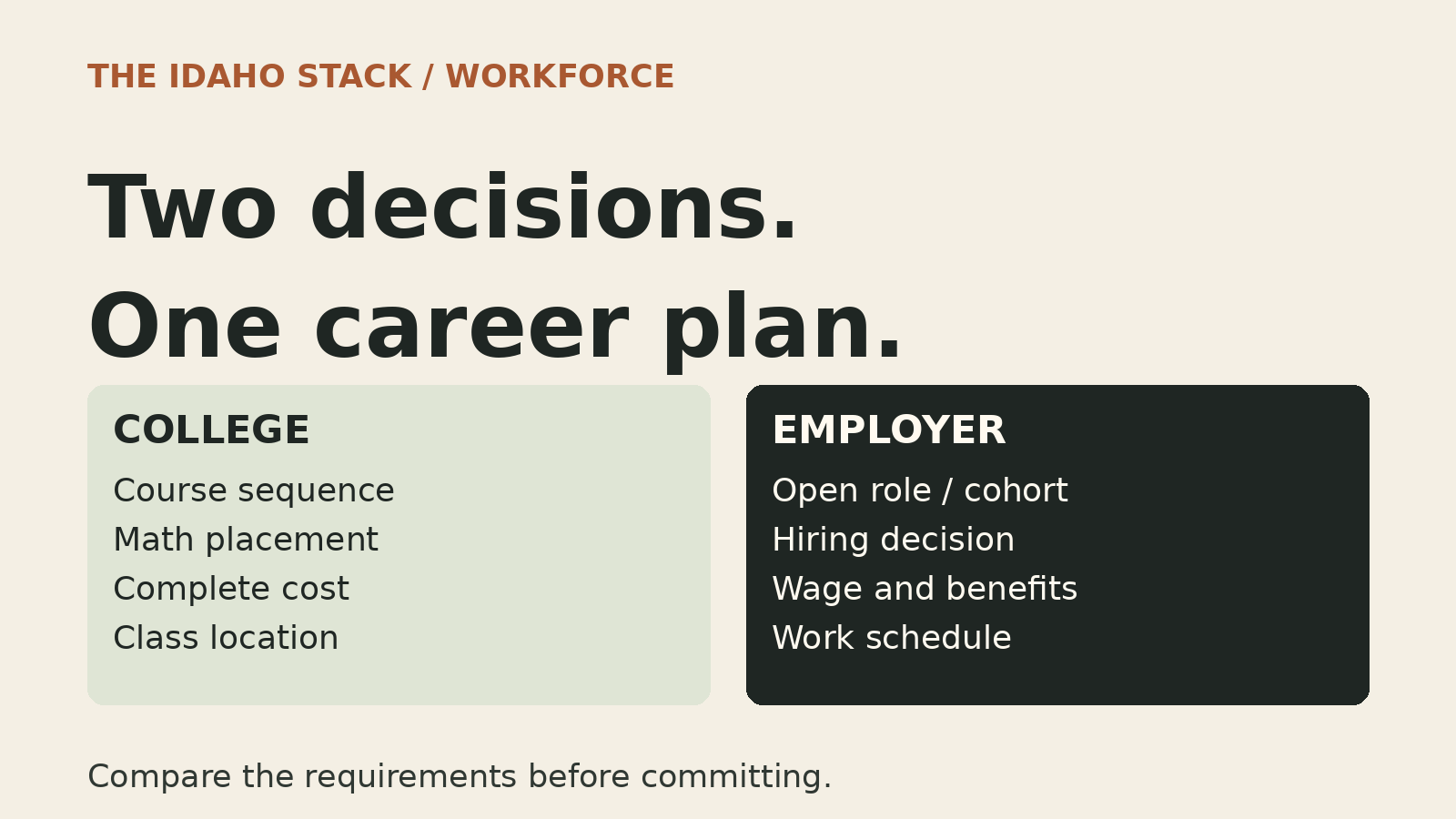
Start with the course sequence
CWI advertises its Semiconductor Manufacturing Technology Basic Technical Certificate as a one-year program. The 2026–27 catalog sets a 16-credit minimum and recommends a fall start: seven credits in fall, nine in spring. Depending on math placement, an alternative algebra sequence adds two credits.
The course descriptions make the timing question concrete. Programming for Semiconductor Manufacturing and Nanofabrication I are listed for fall. Quality Control and Statistical Processing and Nanofabrication II are listed for spring. Nanofabrication II requires Nanofabrication I.
That is a reason to ask advising for a personal sequence before paying for classes. It is not proof that spring entry is impossible: prior credit, math preparation and available sections could change an individual plan. We have not verified spring semiconductor seats or a new January cohort.
Bring this question: which courses can I actually take in spring, which must wait, and what is my earliest realistic completion term? A one-year program description is useful only after the student knows where they enter the sequence.
Keep enrollment and employer hiring distinct
CWI’s partnership page describes Micron apprentices as full-time employees combining work with technical coursework. Micron’s own apprenticeship overview says the program pays wages, provides benefits and covers tuition while apprentices pursue approved technical education. Its Idaho section says openings are posted as cohorts become available.
Taking a CWI course therefore should not be treated as acceptance into Micron’s paid program. Nor is the existence of a past apprentice cohort evidence of an open job today. This review did not verify a currently available apprenticeship vacancy or an entry wage.
Work hours deserve the same attention as classes. Micron’s general FAQ says typical shifts run 12 hours, with some eight-hour roles; schedules vary with training and classes. Ask which schedule applies to the specific opening, whether class time is accommodated, and what the actual offer pays. An occupational median on a college careers page is not a starting-wage offer.
Price the whole plan, and check the building
The program page lists $3,207 and warns that additional costs may apply. Treat that as the college’s advertised program figure, not a complete personal attendance budget. Request the tuition and fee breakdown for your residency and course plan, then add books, required supplies, transport and any work hours you would give up. Confirm aid or employer coverage for your own situation before relying on it.
Location is another detail worth resolving. Micron Day is at the Nampa Campus Micron Education Center, 5725 E. Franklin Road. CWI advertises hybrid semiconductor classes with scheduled in-person learning at the Micron Training Center, 7075 S. Eisenman Road in Boise, Red River Commerce Center Building C. The event venue and the advertised training location are different places.
For someone outside the immediate Boise–Nampa area, the usable question is how many in-person trips a particular section requires, at what times, alongside which work shift. Hybrid does not mean the program can be completed entirely from home.
Leave with two written next steps
- From the college: a course-by-course start and finish plan, any placement work, exact class locations and a personal cost estimate. The catalog provides a route to One Stop Student Services for help getting started.
- From the employer: the current job or apprenticeship posting, qualifications, cohort timing, wage, shift and next hiring step. Ask which education is required before applying and which is taken after selection.
That turns a broad promise about Idaho’s chip economy into something a household can evaluate: a schedule, a budget, an application and a next decision.
Sources and method
Public sources reviewed October 17, 2026: CWI’s September 16 event notice, October 15 registration notice, current program and campus pages, the 2026–27 certificate and course catalog, and Micron’s apprenticeship overview and FAQ. Institutional and employer descriptions are attributed, not independent placement-rate evidence. No current vacancy, individual aid award, live class seat or job outcome was verified.
The course comparison is our analysis of the published plan. Confirm current event arrangements and individual course availability with the institution before travel or enrollment.
- Micron Day notice and public schedule
- Spring 2027 registration dates
- Certificate requirements and recommended plan · SMT course descriptions and prerequisites
- CWI program cost, format and location · Micron apprenticeship conditions and hiring link
For a documented correction, send the claim and supporting source.