
Public-document reporting · Broadband & infrastructure
Four Providers Withdrew From Idaho’s Broadband Plan. What Happens to Those Locations?
An October state briefing describes a major reshuffle of rural broadband awards. For households waiting on a connection, the useful question is whether their own location still has a provider, an agreement and a credible route to service.
Researched and written with AI using the public documents linked below. No interviews or site visits were conducted.
Idaho’s broadband plan has changed since our May look at its contracting deadline. The October 1 Idaho Broadband Advisory Board briefing book, covering April through September, says four provisional providers withdrew, returning approximately $164.4 million in awards and 25,393 broadband serviceable locations for reassignment.
With other project changes included, the returned-location total reached 26,232. The packet describes an August 14–24 competitive rebidding round and says bids covered that total. Its separate table of new rebid projects lists 16,899 locations; those figures describe different things and should not be treated as proof that every returned location has a final replacement award.
The office planned further bidding for remaining eligible locations after federal review. It warned that remaining-location and funding estimates were preliminary until NTIA confirmed and the state reconciled the location list. This is a snapshot from the October briefing, not confirmation of every project’s status today.
Keep the money categories separate
The state’s BEAD Final Proposal page describes a roughly $583 million federal program, approved in December 2025 with a formal award notice in January 2026. That statewide allocation differs from the $426.2 million original project portfolio described in the October packet. Neither number is a measure of completed connections or money already spent.
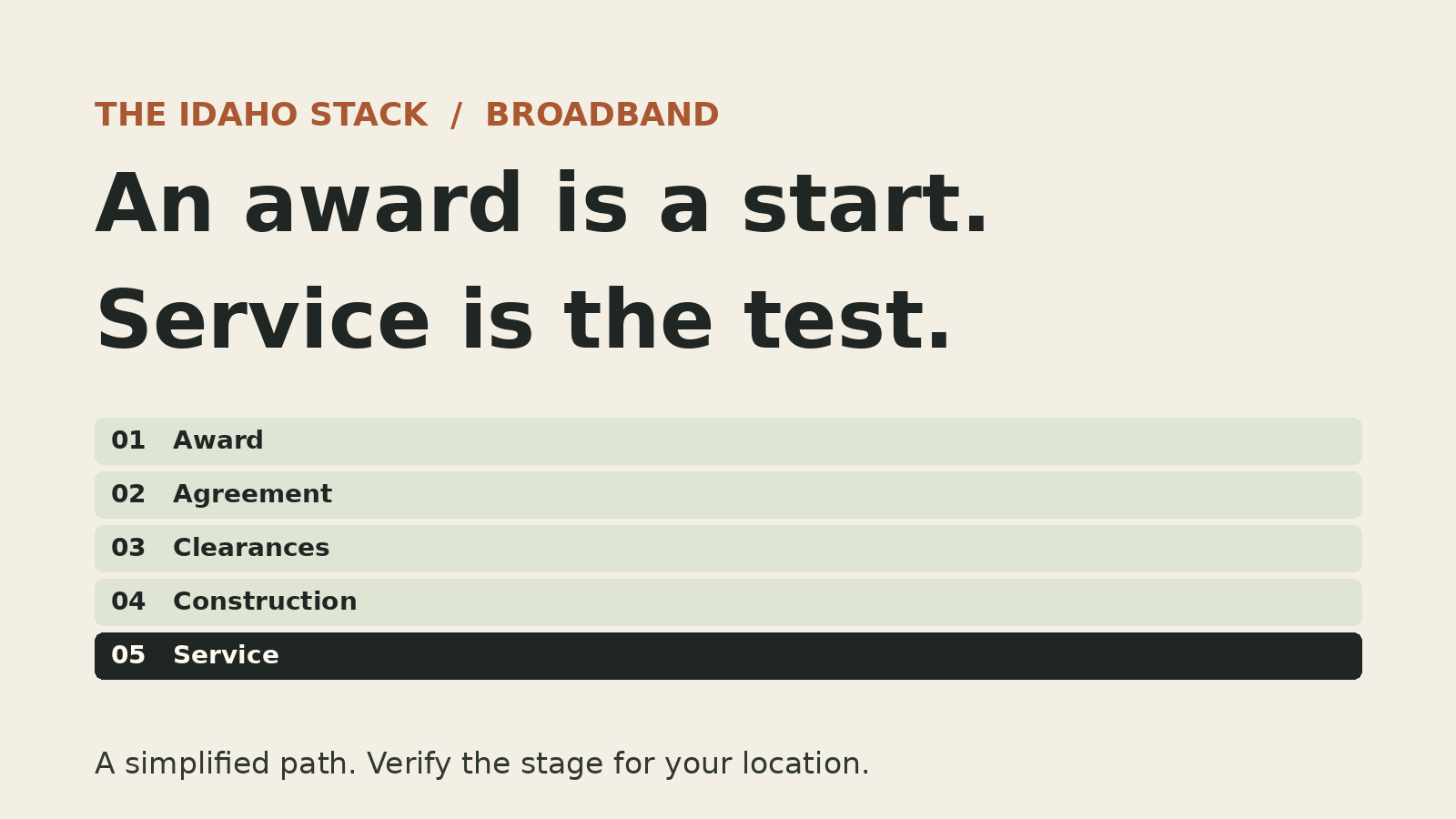
For a resident, those distinctions matter more than the largest headline figure. A program allocation establishes the funding envelope. A project award identifies proposed work. A signed agreement creates obligations. A working connection is the outcome a household can use.
A signed agreement still leaves work ahead
The state’s August 18 subgrantee FAQ explains that environmental and historic-preservation review follows agreement execution. Construction requires the relevant federal approval and the necessary permits and access rights for the initial construction phase. A contract date therefore cannot stand in for a service date.
The FAQ also distinguishes milestone payments from actual expenditure. Its initial disbursement requires an executed agreement and supporting documentation; the next milestone adds environmental obligations, federal approvals and access permissions. An award announcement, a payment and a completed network describe different stages.
Check the location, not just the colored area
The August 20 rebidding FAQ warns that some locations inside an application project area may already belong to another provider’s award or be ineligible. Its map guidance also says the rebidding map did not show every requested project change, and that a comprehensive update would follow bidding, state decisions and federal approvals. That warning describes the August map; it does not establish how recently today’s dashboard has been updated.
Use the state’s Final Proposal resource page to reach its awards dashboard and location files. The dashboard is an interactive application; this review did not verify individual addresses in it. The following is a checking method, rather than an address-level finding:
- Identify your location. Save the project area and location identifier if the state’s resources provide them. A town name alone is too broad.
- Check the record’s date and stage. Look for the assigned provider, any award amendment and whether an agreement has been executed. Save the date of the information you used.
- Separate a build schedule from an order. For service available now, check the provider’s address-specific ordering information, installation timing, full price and equipment requirements.
- Resolve a mismatch before relying on it. The state’s contact route is a starting point for questions about location eligibility or provider assignment. Keep a dated record of the answer.
A household planning remote work, school or a home business needs a reliable connection date and price. Until those are confirmed for its location, a statewide award total is context for that decision, not a substitute for it.
Sources and method
Public sources reviewed October 16, 2026. The state’s meeting archive, program resource pages and news page were checked for newer material; no later portfolio reconciliation was identified in those pages. The packet is a briefing document, not a transcript or proof of later approvals. Its inconsistent references to 43 and 45 contracted projects are not resolved here, so this article does not report a definitive contracted-project count.
- October 1 board briefing book — PDF pages 10–17; original portfolio, withdrawals, rebidding and remaining-location caveat.
- Subgrantee FAQ, August 18, version 6 — PDF pages 5–9; review, construction and payment stages.
- Rebidding FAQ, August 20, version 2 — PDF pages 6–7; location and map limitations.
- Final Proposal resources and subgrantee resources — official links to maps, agreements and guidance.
- Board document archive and program news — current-source checks.
Have a documented correction? Send the page, claim and supporting source.