
Public-document reporting & analysis · Energy & nuclear
MARVEL’s Safety Approval Sets Up a Physics Test in Idaho
A reactor can sustain a chain reaction while producing almost no power. That distinction explains the next experiment being prepared at Idaho National Laboratory—and how to read the milestones that follow.
Researched and written with AI using public documents. No interviews or site visits were conducted. This is reporting and analysis of published material, not an independent reactor safety assessment.
Idaho’s role in nuclear technology includes the work that happens before a reactor can deliver useful energy. MARVEL, a Department of Energy microreactor project at INL, now offers a concrete example.
In an October 6 announcement, INL said DOE’s Idaho Operations Office had approved the project’s final documented safety analysis for a dry criticality configuration. The lab also reported delivery of its primary coolant system in September for integration with other equipment. Those are separate milestones: an authorization for a particular test and the arrival of hardware for the project.
The dry test is intended to produce reactor-physics benchmark data at near-zero power, with no coolant present, according to INL. The announcement describes preparation for testing; it does not report that MARVEL has completed that experiment.
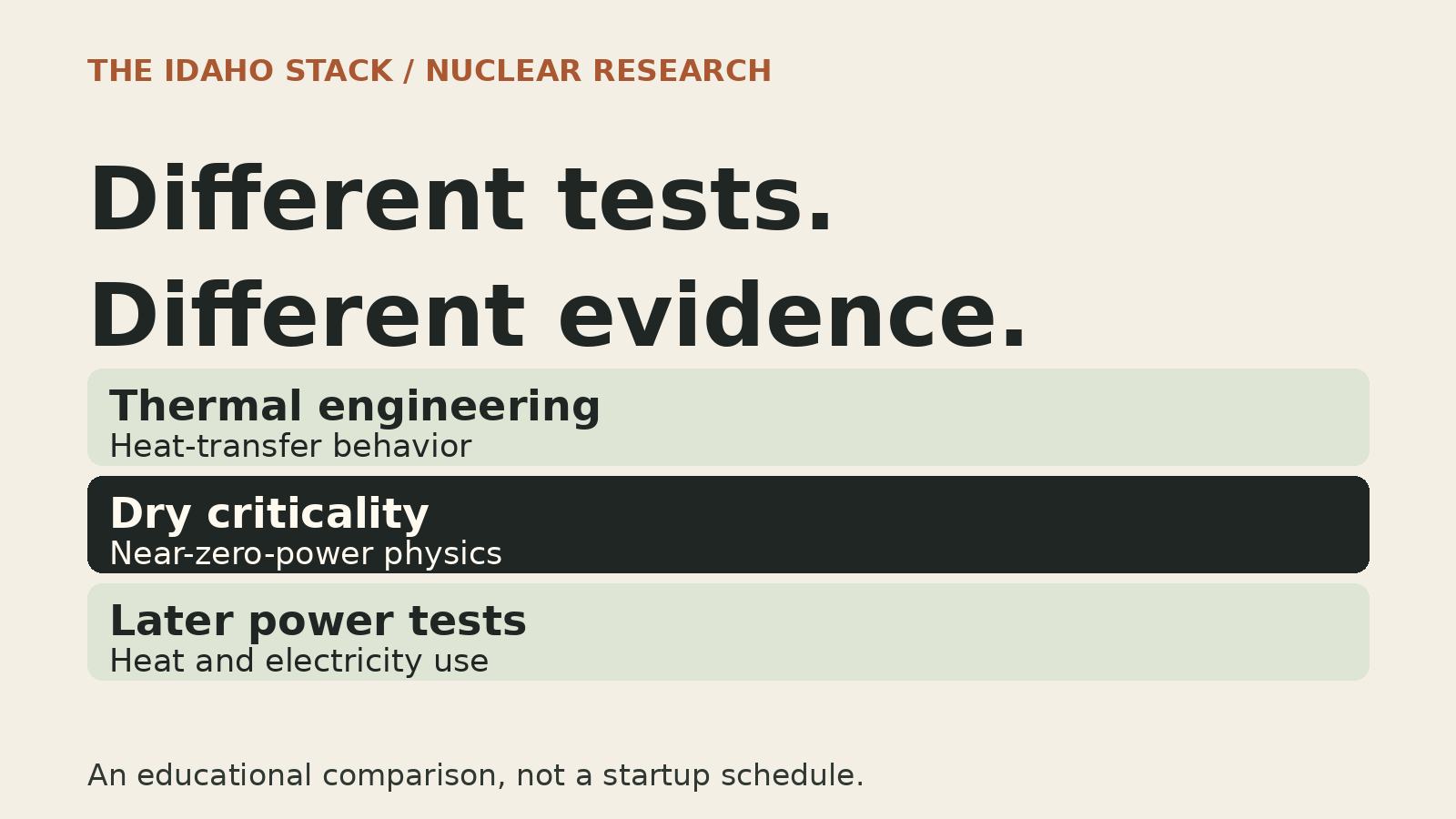
What “critical” tells a reader
In its June 24 explainer, DOE defines criticality as a stable, self-sustaining fission chain reaction: neutrons from fission sustain the next generation of reactions. The term describes the balance of that reaction, not how many kilowatts a facility is delivering to customers.
For MARVEL’s announced dry configuration, that makes physics measurements the immediate output to look for. Useful electricity, heat delivery and customer applications require additional evidence. An announcement about one stage should be read at that stage.
Cooling tests answered a different question
The project’s public April 2025 fabrication and testing report explains why an electrically heated engineering demonstration unit was valuable before nuclear operation. It documents lessons from the Primary Coolant Apparatus Test, or PCAT, and guard-vessel fabrication. Its executive summary describes how non-nuclear testing can expose engineering questions and inform the final design.
This is a useful distinction for Idaho readers following advanced reactors. Testing how equipment transfers heat is not the same experiment as testing the physics of a sustained chain reaction. Both can advance a project without establishing that a complete energy system has delivered its intended service.
The report is historical evidence of the development process. It is not a measurement of MARVEL’s current electrical output or a substitute for the newly approved safety document.
The later goal is an experimental energy system
DOE’s MARVEL project page describes a test bed at INL’s Transient Reactor Test Facility designed for 85 kilowatts of heat and approximately 10 kilowatts of electricity. Thermal output and electrical output are different quantities; they should not be combined or used interchangeably.
The same page says MARVEL’s design is not intended as a commercial product. Its purpose is to help developers investigate applications. That makes eastern Idaho’s contribution a research platform and a source of evidence for future systems—not a demonstrated addition to a utility’s power supply.
There are practical questions behind that research. Can nuclear heat serve a particular process? How can controls coordinate a reactor and an electrical load? What measurements are needed to evaluate the coupling? Answers from a test bed can inform later designs; they do not by themselves establish an affordable commercial service.
INL’s December 2025 initial experiment selections included proposed data-center, controls, sensor and pilot-scale desalination applications. That announcement described further feasibility and implementation work. We have not verified final agreements or completed demonstrations for those proposals.
Read the forecasts separately from completed tests
The October 6 release anticipated initial criticality in December. The DOE project FAQ and INL project FAQ reviewed on October 18 instead list dry initial criticality in 2027 and full-power operations in 2028. Those are different published forecasts. This article does not select a firm startup date or infer that either projected test has occurred.
For a resident, student or business following Idaho’s energy economy, the next useful record will specify what was actually completed: the test configuration, its power level and the measurements obtained. Later reports can establish heat delivery, electricity generation or an end-use demonstration in their own terms.
That is how to follow progress without requiring every research milestone to stand in for a finished power plant.
Sources and limits
Public sources reviewed October 18, 2026. We compared INL’s October announcement with DOE/INL project descriptions, the April 2025 technical report and the initial end-user selection notice. Forecasts and capabilities remain attributed to the institutions; the distinction between test stages is our analysis.
We did not access or independently assess the full approved safety analysis. INL’s project page describes a registration and approval process for its technical repository; no account or access request was created. No operating output, final experiment agreement, commercial cost or utility procurement was independently verified.
- October 6 safety and coolant-system announcement
- DOE project overview and FAQ · INL overview, FAQ and data-access description
- DOE’s criticality definition
- INL/RPT-25-84647, April 2025 — executive summary, PDF pages 5–8.
- Initial end-user selections, December 4, 2025
For a documented correction, send the claim and supporting source.