
Desk note · Data centers · SEC records
Declo Data Center Developer Reports No Revenue and Doubts It Can Keep Going, SEC Filings Show
TerraVolt Holdings wants to build a 240-megawatt, gas-powered data center campus east of Declo. Its own filings show $10.7 million in cash, no revenue, a loan from a director’s family trust and a warning about its future. Cassia County commissioners hear from residents Tuesday night.
Based on public documents. No interviews were conducted.
On October 30, TerraVolt Holdings told investors it had secured options on about 1,077 acres of farmland outside Declo, along State Highway 81 near Interstate 84 and the Williams Northwest Pipeline. The plan, in the company’s press release, is an initial 240 megawatts of on-site gas generation, cut off from the grid, feeding data center buildings the company would sell to operators.
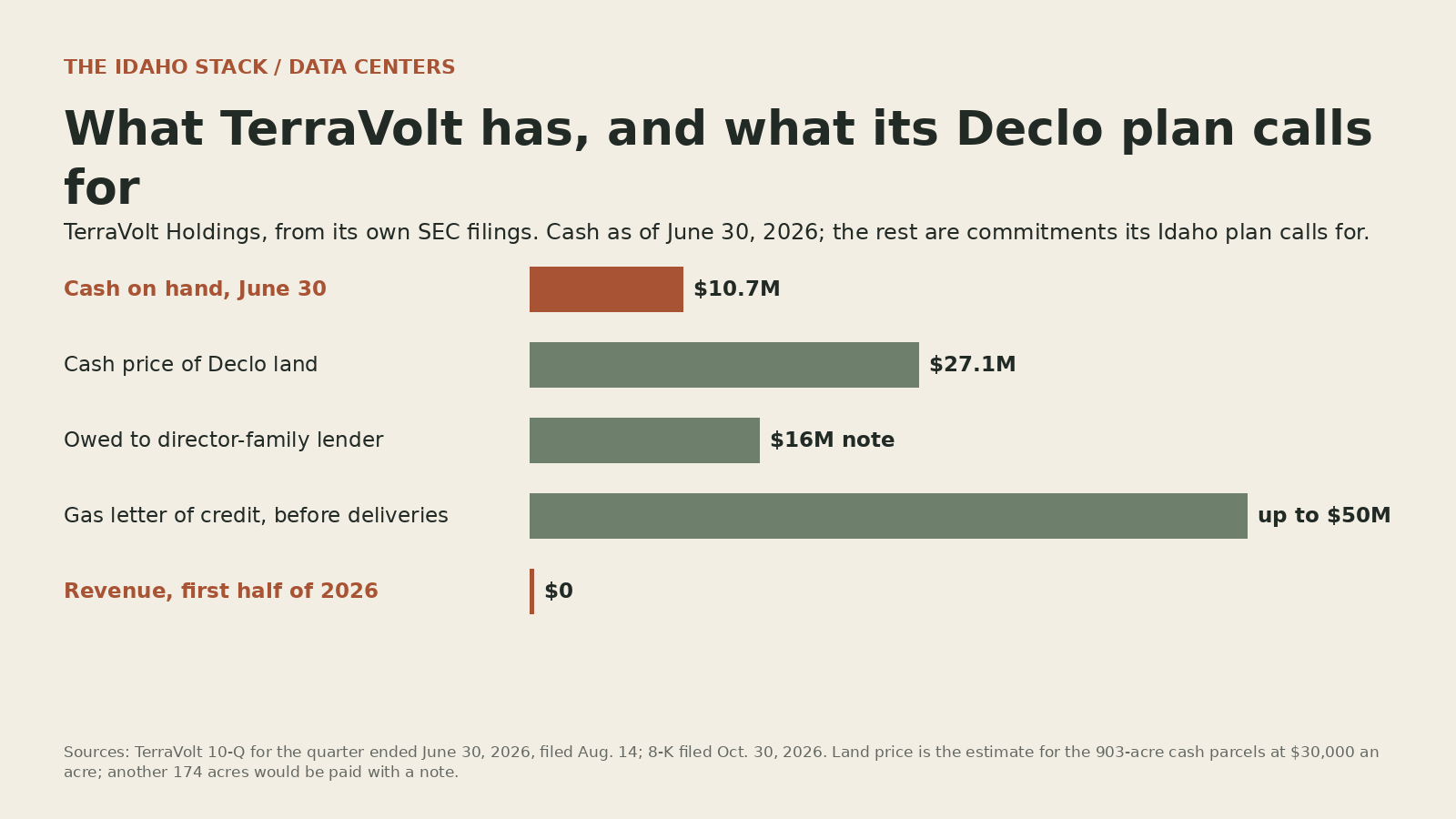
The company’s latest quarterly report, filed with the SEC in August, describes who would build it. TerraVolt, a Tustin, California, company quoted on the OTC market and known as CalEthos until this summer, had no revenue in the first half of 2026. It lost $2.2 million over those six months, has piled up $40.6 million in losses since it began, and owed more than it owned at the end of June. The filing puts it plainly: “These conditions raise substantial doubt about the Company’s ability to continue as a going concern.”
An option, not a purchase
The 8-K filing and its two option agreements with Wickel Land Company, a Declo farm partnership, set the price at $30,000 an acre. About 903 acres would be paid in cash, an estimated $27.1 million. The other 174 acres, about $5.2 million, would be paid with a two-year note that converts to TerraVolt stock at $5 a share. To hold the land, TerraVolt put down $150,000, half of it nonrefundable. The options run to October 23, 2027, with one six-month extension, and both must be exercised together.
One clause matters this week. The option agreement stops its clock “during any period in which litigation, a governmental moratorium, or other similar circumstance” delays the project, with no outside limit. If Cassia County paused data centers, as Blaine and Bannock counties have, TerraVolt’s option would wait it out.
The land is zoned Multiple Use. The 8-K describes the company’s product as “pre-permitted, construction-ready” building sites, but the option agreements expect TerraVolt to seek amendments to the county’s Multiple Use zoning rules and conditional use permits, and its press release lists state and local zoning, environmental and development permits among its risks. Data centers are not a permitted use in Cassia County, KIVI reported. As of June 30, the 10-Q says, “the Company had not secured land to be used for the proposed data center campus.”
Where the money came from
TerraVolt had $287,000 in cash at the end of 2025 and $10.7 million at the end of June. The difference is mostly one loan. On April 23, SFO IDF LLC advanced $15 million in exchange for a $16 million note at 8 percent, due April 30, 2028, and a warrant for 6 million shares at 50 cents each. The 10-Q says SFO IDF is owned by “a trust established for the benefit of certain family members of Sean Fontenot, a director of the Company,” with independent trustees. TerraVolt also agreed to pay the lender up to $37.5 million more out of future sales or leases of the campus’s first-phase sites.
The gas comes with its own bill. TerraVolt has a firm supply deal for 55,000 MMBtu of natural gas a day and paid about $3.8 million in May to reserve it. It must name a start date for deliveries by April 30, 2028, and post a letter of credit of up to $50 million before the gas flows. The supplier is not named.
Water and power
TerraVolt says every building on the campus must use low-water cooling, such as closed-loop systems, as a condition of each site sale. Because the power would be generated on site and not sold to the grid, the project appears to fall outside the Public Utilities Commission’s cost test under the state’s new large-load law, which covers utility service contracts for new loads of 50 megawatts or more. The filings name no tenant and give no construction date. The 240 megawatts is generation capacity; the filings do not say how much computing load it would serve.
What happens next
Cassia County commissioners will attend a community meeting on the project Tuesday, November 10, from 7 to 9 p.m. at the Declo High School auditorium. The county’s notice says “No action items will be considered and no deliberation will take place.” The county’s planning and zoning commission meets November 19; no agenda was posted as of November 8. TerraVolt’s next quarterly report, for the three months ended September 30, is due around mid-November and should show what it has spent since June. Follow the project on our Idaho data center tracker.
What the public record doesn’t show
Who would buy the sites, who supplies the gas, where the campus’s water would come from and how much, and whether TerraVolt can raise the cash to close on the land. Know more? Send us a tip.
Sources and limits
Public records reviewed November 9, 2026.
- TerraVolt Holdings, Form 8-K, report date October 26, signed October 30, 2026, with the cash parcels option agreement, the stock parcels option agreement and the October 30 press release
- TerraVolt Holdings, Form 10-Q for the quarter ended June 30, 2026: balance sheet, statements of operations, Notes 1 to 3
- Cassia County, special commission meeting notice, posted November 6, 2026
- House Bill 911 (2026), new large loads, effective July 1, 2026
- KIVI, November 2, 2026
Figures are from TerraVolt’s own filings and are unaudited quarterly numbers. The land price is the company’s estimate; final acreage depends on a survey. The going-concern language is the company’s, not a finding by The Idaho Stack. We did not contact TerraVolt for this note.