
Public-document reporting & analysis · AI & Public Administration
Idaho’s Court AI Report Connects Chatbot Plans to Document Control
The information behind a chatbot needs an owner, an approval process and a way to stay current. Idaho’s newly released court AI report makes that work part of evaluating a possible operational assistant.
Based on public primary documents, rechecked October 26, 2026. No interviews, internal-document access or chatbot testing were conducted. This article concerns court administration, not advice about a filing or case.
On October 19, the Idaho Supreme Court released an AI governance report developed with the National Center for State Courts. The report is dated August 2026; October 19 is its public-release announcement date. The Court says the document does not adopt or require an AI tool.
That distinction matters for Idahoans trying to understand what AI might do inside a public institution. An exploration, an adopted principle and an operational service establish different things. The report supplies a detailed account of the first two without demonstrating a new service’s results.
The proposed assistant leads back to the documents
The report’s court-operations section describes exploration of a knowledge-management and operational chatbot. That work brought ownership of manuals, updates, review and approval procedures into focus. The report says the initiative did not deploy a production AI solution. Its earlier pilot plan was set aside while governance and readiness work continued.
This is a specific administrative question: what makes a document authoritative enough for a tool to rely on? A collection of files needs decisions about which material is approved, which version applies and who can authorize a change.
Consider an illustrative office procedure with an old copy and an approved replacement. Finding both files quickly would not resolve which one staff should use. The responsible team would still need to identify the controlling version and determine how the old copy is retired or clearly distinguished. This example is hypothetical; it is not a finding about an Idaho court manual.
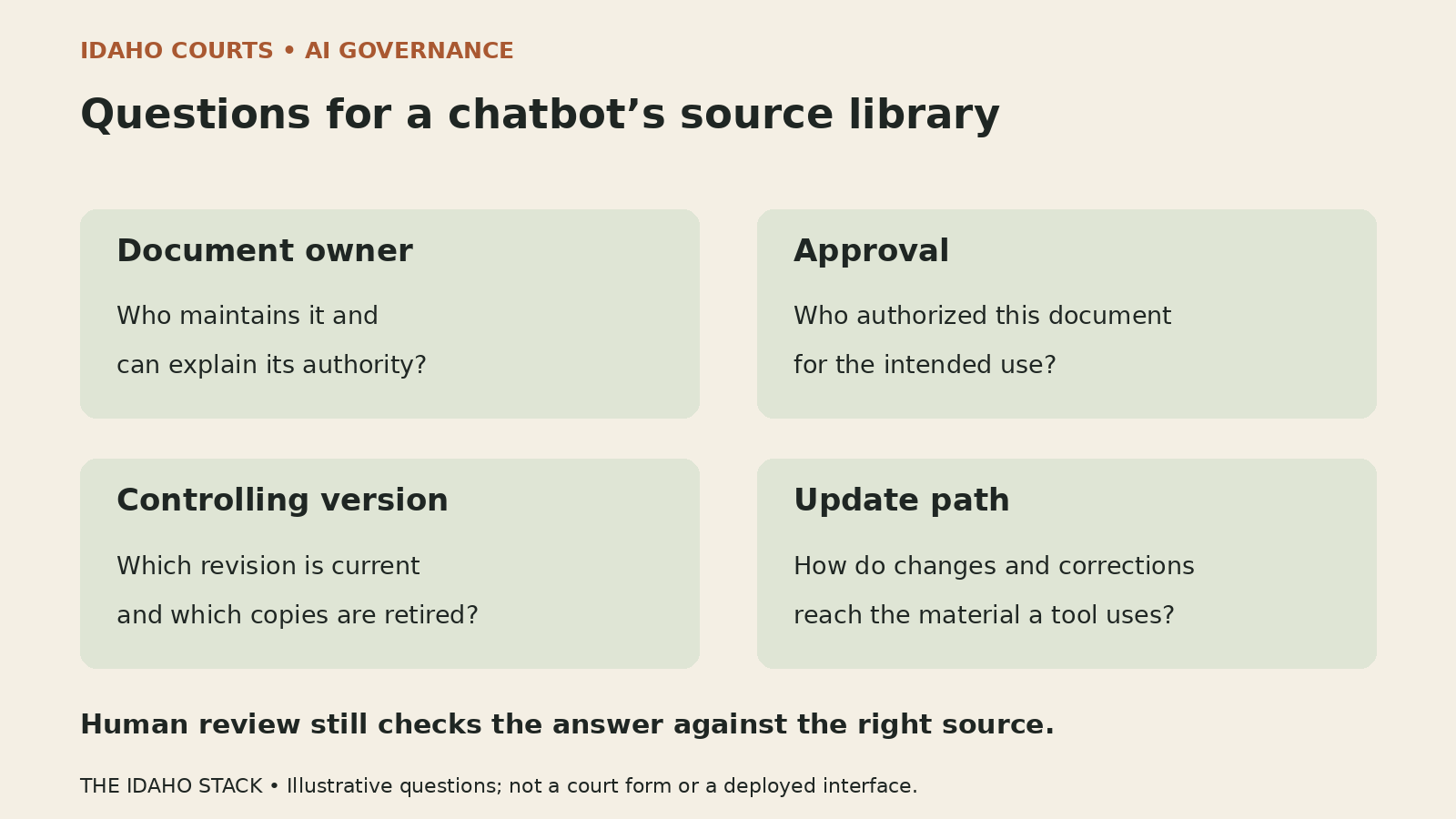
The practical consequence is that an AI project’s work list includes the information it uses. A procurement description or demonstration can explain a tool’s features. A source-governance plan should explain the authority behind its answers.
Human review has to remain a real responsibility
The Court’s adopted guiding principles preserve independent judicial judgment and final human responsibility. They call for documented, validated and tested systems, continuing oversight and education for people using the tools. The principles also address confidentiality, fairness and accessibility.
For an internal reference assistant, meaningful oversight would require a reviewer who can check the answer against the relevant source and recognize when a question needs a person’s judgment. That is our operational interpretation of the principle, not a description of an installed Idaho system.
A visible source reference could help that check. It would not, by itself, establish that the source is current, that the answer represents it accurately or that the use is permitted. The supporting process and the human reviewer remain part of the result.
The same principles emphasize involving people who know the work and training them to monitor outputs and provide feedback. That connects accountability to a role a person can perform.
Trace the source and the change
There is a useful independent technical reference for this issue. NIST’s Generative AI Profile includes tracing the origin and modification of digital content. It also describes documenting data provenance, quality, methods and limitations. NIST presents the AI Risk Management Framework as voluntary guidance; it is not an Idaho court rule or proof that a particular system complies with one.
Applied to the hypothetical procedure, those questions concern the life of the information: who supplied it, who approved it, what changed and how a correction reaches the material available to the tool. They are useful questions even before choosing a model or software supplier.
For readers following the Court’s next decision, the evidence to look for is concrete: a defined use, the authority for its source material, assigned review responsibilities and results from testing. A plan for an assistant is not a measured reduction in waiting time, staff effort or cost.
The October announcement says further policy decisions remain with the Supreme Court. It distinguishes the already adopted principles from other proposals, including an ongoing advisory committee. The report’s draft orders, policies and roadmap should be read in that status.
For Idaho’s public technology choices more broadly, this offers a useful way to evaluate an AI proposal: identify the information and people that make its output usable, then ask what the evidence shows about the service it is meant to improve.
Sources and limits
Primary materials researched October 22 and rechecked October 26, 2026. Reporting draws on the Court’s release, the National Center for State Courts’ report and the separate principles sheet. Our document-control example and review questions are analysis. The NCSC report permits reproduction with attribution; this article uses limited paraphrases.
- Supreme Court announcement, October 19, 2026 — release and adoption status.
- NCSC, AI Governance Implementation, August 2026 — printed pages 7 and 36–40 (PDF pages 8 and 37–41): pilot status, operational chatbot exploration and document governance.
- Idaho Judicial Branch AI principles — one page; human responsibility, validation and oversight.
- NIST AI 600-1, July 2024 — PDF pages 32 and 39, actions MS-1.1-001 and MS-2.9-002; publication record and scope.
No actual chatbot, confidential source library, procurement, current branch-wide tool inventory, cost saving, case outcome or operating performance was independently assessed. This report does not claim that every Idaho court uses—or does not use—AI. This piece examines the report and its release announcement; it is not a current branch-wide tool inventory.