
Desk note · Public money · Data centers
Six Years In, Idaho Has Never Put a Price on Its Data Center Tax Break
The state estimates what its smaller tech sales tax exemptions cost, down to the thousand dollars. The 2020 break written for large data centers has no line, and no law requires one.
Based on public documents. No interviews were conducted.
In 2020 Idaho exempted large new data centers from sales tax. The law, Idaho Code 63-3622VV, covers server equipment, including servers, storage, chillers, generators and cabling, and the data center buildings themselves, with their materials and fixtures. To qualify, a company certifies to the Idaho State Tax Commission that it will invest at least $250 million within five years of starting construction and create 30 full-time jobs, paying at least the county’s average weekly wage, within two years of opening. Until it meets both marks, its exemption is provisional. If it misses either one, it owes the tax back.
No one has published what the break costs. The 2020 bill, House Bill 521, carried a fiscal note saying only that it “will have a positive impact on the general fund.” The only dollar estimate on record belongs to a version that never passed: the fiscal note for 2019’s House Bill 279 put the cost at $600,000 a year, assuming ten businesses each spending $1 million a year on servers. The same note said a single $250 million project, the size the 2020 law requires, “could produce up to $15 million in sales taxes.” And the statute requires no report to the Legislature or the public on who claims the exemption or how much tax goes uncollected.
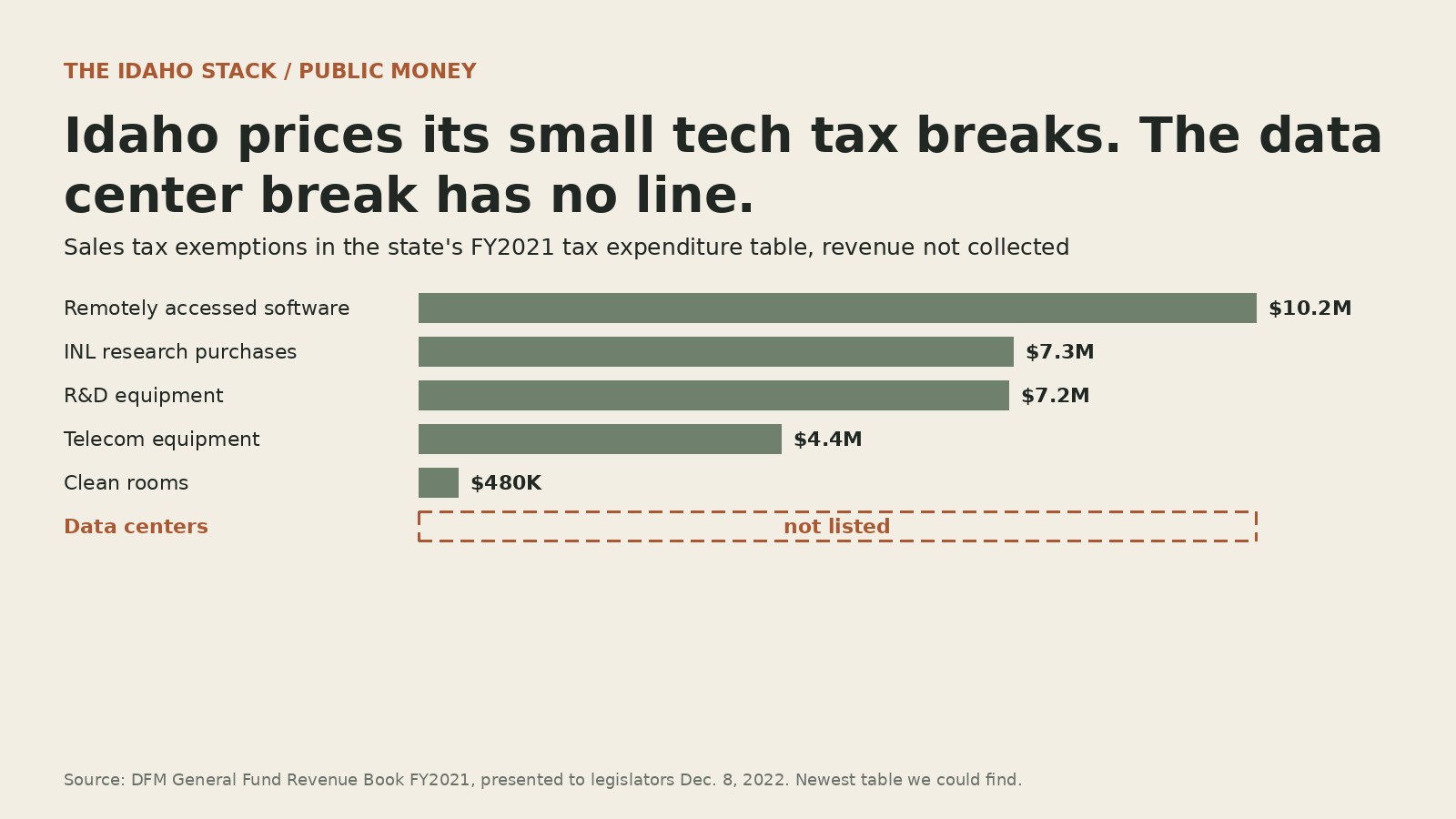
Missing from the state’s own table
The gap stands out in the state’s own accounting. The Division of Financial Management’s General Fund Revenue Book estimates what Idaho gives up through each sales tax exemption. Its FY2021 table, the most recent edition we could find posted, was presented to a legislative interim committee in December 2022. It prices the state’s smaller tech exemptions one by one:
| Exemption | FY2021 estimate |
|---|---|
| Remotely accessed computer software | $10,210,000 |
| INL research and development purchases | $7,251,000 |
| Research and development equipment | $7,200,000 |
| Telecommunications equipment | $4,421,000 |
| Clean rooms | $480,000 |
| Data center equipment and facilities | Not listed |
The table runs to 108 numbered exemptions. None is the data center break. The state’s own column header says “CY2021” while its source line says FY2021, and the document notes its sales tax estimates carry a margin of plus or minus $50 million in total. DFM’s publication listings showed a technical-issue notice when we checked on November 6, so we could not confirm whether a newer edition adds a line.
Two tries to require a number
Lawmakers have tried to change the break twice. In 2025, House Bill 315 would have narrowed it. In 2026, Sen. Lori Den Hartog and Rep. Chris Bruce came back with House Bill 609, which never left the House Revenue and Taxation Committee, and then a reworked version, House Bill 897. Neither 2026 bill’s fiscal note put a dollar figure on the existing break.
As introduced, House Bill 897 would have had the Tax Commission report each year the approximate sales tax not collected from data centers. The Senate’s amendment added a requirement that each data center report to the Commission every year on its exempt purchases, jobs, investment, power and water use. It passed the House 68-0 on March 23 and the Senate 34-0 on April 1, after the Senate amended it. The House never voted on the Senate’s changes, and the bill died when the session ended. The House has a long-standing policy of not taking up tax bills amended in the Senate, BoiseDev reported. The statute still shows only its 2020 enactment, so the reporting it would have created does not exist.
Who holds the exemption?
Even that is unclear in the public record. Minutes of a March 25, 2025 Senate Local Government and Taxation hearing on House Bill 315 record two opposite accounts:
- Steve Thomas, representing Meta Platforms, testified that the Tax Commission “denied Meta a tax exemption due to it’s provisional exemption status which would be in place until they opened.”
- Rep. Bruce “clarified that ISTC had explicitly stated that Meta had received their sales tax exemption.”
Both can be true. Under the statute, a provisional exemption applies up front and becomes final only once the investment and jobs arrive. But the public can’t check which applies, or what it’s worth. Idaho’s sales tax is 6 percent, so every $100 million of exempt purchases is $6 million the general fund doesn’t collect. Meta’s data center in Kuna is under construction, BoiseDev reported this spring. A second Kuna project, from Diode Ventures, has city approval but was on hold over a lawsuit, BoiseDev reported.
Who pays for these projects’ electricity is a separate, open question, which we covered in “Who Pays for the Power?”
What the public record doesn’t show
How many provisional exemptions the Tax Commission has issued under 63-3622VV, what they are worth in uncollected tax each year, and whether any has become final or been repaid. If you know, send us a tip.
We follow every Idaho data center project, and what is known about its tax treatment, on our Idaho data center tracker.
Sources and limits
Public records reviewed November 6, 2026.
- Idaho Code 63-3622VV, Idaho information technology equipment (added 2020, ch. 335; no later amendments listed)
- House Bill 521 (2020), bill history and statement of purpose and fiscal note
- House Bill 279 (2019), which died in committee, and its fiscal note
- Division of Financial Management, Idaho sales tax expenditures, General Fund Revenue Book FY2021, as presented December 8, 2022
- Senate Local Government and Taxation Committee minutes, March 25, 2025 (summary minutes, not a transcript)
- House Bill 609 (2026) and fiscal note
- House Bill 897 (2026), bill history, statement of purpose and Senate amendment
- BoiseDev, March 3, 2026 and on the bill’s end
- Idaho State Tax Commission, sales and use tax guide (6 percent rate)
The cost table is DFM’s estimate, not an audit. A provisional exemption is not a final one, and we have not seen any company’s filings. Committee minutes summarize testimony; the quotes above are the minutes’ wording.