
Public-document reporting & analysis · Public systems
Idaho’s Fraud Review Raises a Practical Question: Who Gets the Report?
A new statewide review will consider how Idaho collects fraud reports. Existing state and FBI instructions show why the handoff after submission deserves as much attention as the form itself.
Based on public primary documents. No interviews, complaint submissions, bank contacts or tests of reporting services were conducted. The design questions below are our analysis; the linked agencies supply the current reporting instructions.
Governor Brad Little announced October 26 that a financial fraud working group will convene November 17. It will consider statewide report collection and ways to coordinate investigation and prosecution, with findings due ahead of the 2027 legislative session. The governor’s office says Idaho lacks a central fraud-report repository and a dedicated statewide financial-crime unit.
That is a review of possible changes. It does not announce an operating statewide portal. For an Idaho household or small business dealing with a suspicious payment, the immediate question remains practical: what does each existing reporting channel actually do?
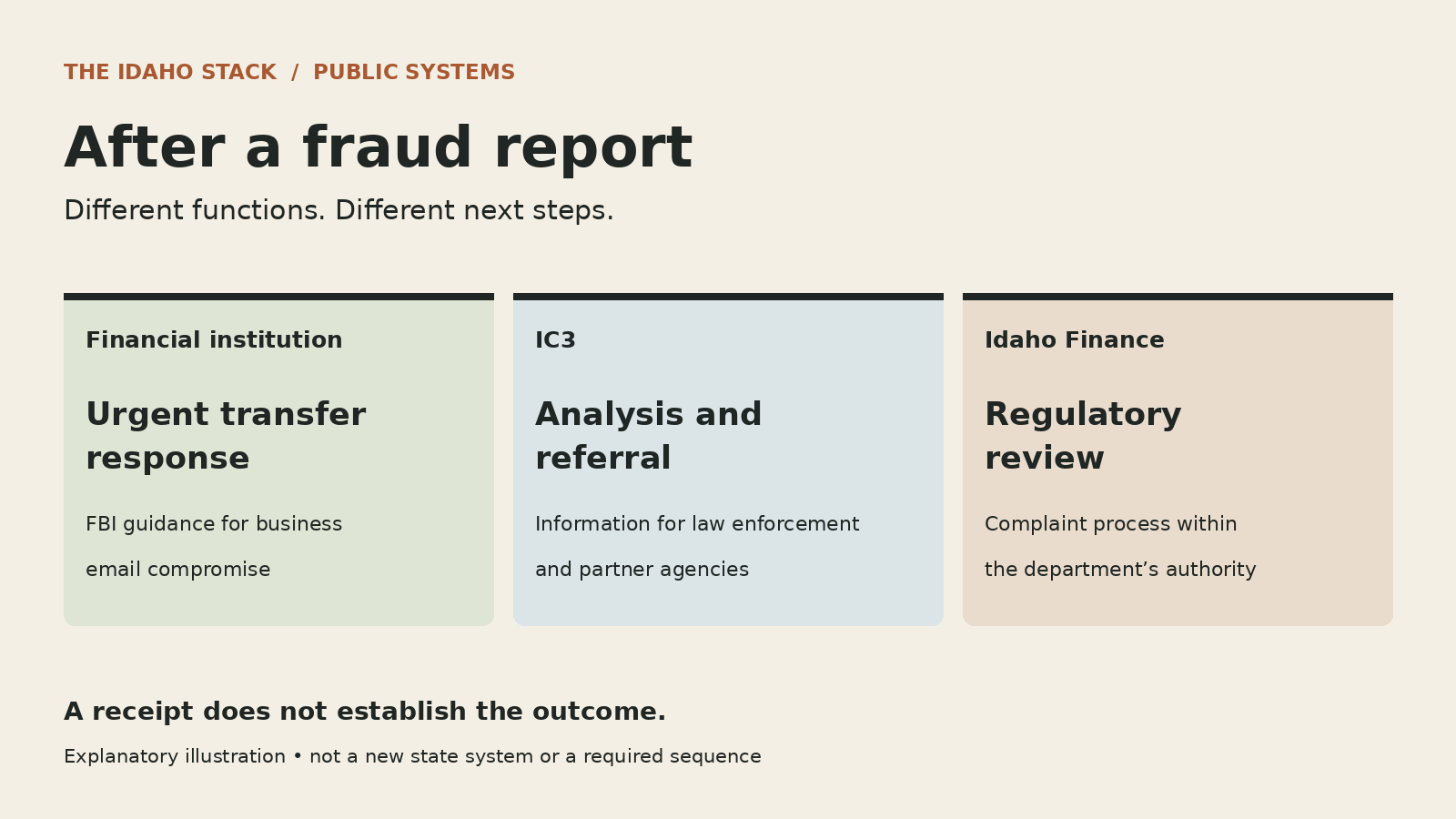
Reading the public instructions together reveals three distinct functions: trying to interrupt a transfer, collecting information for law enforcement, and reviewing a regulated business’s conduct. A useful future system would help a person understand which function has begun and who handles the next step.
What the existing instructions promise
The FBI’s business email compromise guidance addresses the urgent payment problem directly. It tells people to contact their financial institution immediately, ask it to contact the institution that received the transfer, and report to the Internet Crime Complaint Center, or IC3. It also advises independently looking up a company’s number when checking a suspicious request.
IC3’s FAQ describes a different task: analysts review complaints and send information to law enforcement and partner agencies as appropriate. The receiving agencies decide whether to investigate or prosecute. IC3 cannot provide the investigative status of a complaint. Its instructions say to save or print the submitted report and to contact local law enforcement directly when a matter is time sensitive.
Idaho’s Department of Finance complaint guidance describes regulatory review. The department sends a notice with a file number, seeks a response from the named business and provides a written position when its review is complete. It says that process may take weeks or months. Its authority has limits; it refers complaints involving institutions outside its regulation to the appropriate agency.
A submission confirmation, a regulatory file number and an urgent request to a bank therefore mean different things. None of these instructions promises that filing a report will recover the money.
The paper form already asks about another agency
A small detail in Finance’s five-page paper complaint form points to the coordination question: it asks whether the person has filed a complaint or contacted another government agency, and which one. It also asks for transaction dates, amounts, payment method and a chronological account of events.
That is a starting point for connecting the history of a complaint. It does not establish that agencies’ databases exchange records or that one submission reaches every organization that might need it. We did not trace an actual complaint through those systems.
The form also warns about sharing the complaint with the business and potential public-record access. Those disclosures matter when deciding what information belongs in a submission. Read the agency’s current instructions and disclosures before filing; a shared reporting design would need equally clear explanations of who receives the information.
The $88.7 million figure has a defined boundary
The governor’s announcement cites $88.7 million in Idaho losses reported to the FBI in 2025. The underlying IC3 annual report lists $88,725,284 for Idaho and, on the preceding page, 4,479 complaints.
Those are complaint-based figures. Appendix C says state statistics depend on location information supplied by complainants. Complaint counts do not represent the number of individual people filing. Some people may file more than once; the FBI says losses are de-duplicated as much as possible, and classifications and losses can change as analysis proceeds.
The figures give the review a documented starting point. They do not measure every fraud loss in Idaho or establish how many distinct Idahoans were affected. A future state total would need its own published definitions before readers could compare it with IC3.
Three questions for the November review
The technology challenge is partly about maintaining the meaning of a record as it moves. These are questions we would use to assess a subsequent proposal, rather than features the state has committed to build:
- What does a receipt mean? A person should be able to distinguish information received, information referred and a case accepted for investigation. Who acknowledges a referral, and where does a time-sensitive matter go?
- How will related reports stay connected? A design could retain the originating agencies’ reference numbers and explain how staff distinguish an update from a separate event. It should also specify who may see supporting documents and who corrects an erroneous link.
- What will the public numbers count? Reports, distinct incidents, reported losses, money frozen and money returned describe different stages. Definitions, reporting periods and revision notes would make any published results easier to assess without exposing individual case details.
The next useful evidence will be the working group’s findings and any actual decisions about authority, staffing, cost and implementation. An intake form can collect a story. Idaho’s review has the opportunity to explain what happens to that story next.
Sources and limits
Primary records reviewed October 28, 2026. The new development is the October 26 review announcement; the existing reporting instructions and 2025 statistics supply context.
- Governor’s announcement, October 26 — planned review, scope and timing.
- Idaho Finance complaint guidance and paper form — regulatory process, reference number, fields and disclosures. The guidance links the current online intake; the paper form is a separate document.
- IC3 FAQ — intake, referral, evidence and urgent matters.
- 2025 IC3 annual report — pages 28–29 and Appendix C, page 62.
- FBI business email compromise guidance — bank contact and reporting instructions.
We reviewed public documents, not individual cases or internal systems. We did not measure response times, evaluate a particular institution, verify a recovery or establish a statewide inventory of reporting services. No new procurement, vendor, budget or implemented system is inferred from the review announcement.