
Desk note · Public money · Cybersecurity
Idaho’s $2.6 Million Cyber Savings Figure Rests on Work It Says Industry Would Have Billed
The state’s technology office wants National Guard cyber teams back for another year. Its own savings math and the federal rule behind the program point in different directions.
Based on public documents. No interviews were conducted. We are sending questions to the Office of Information Technology Services and will update this note with any response.
Idaho’s Office of Information Technology Services posted a notice of intent on August 27 and a second notice on September 14. Both say the office plans to ask the federal Innovative Readiness Training program for help with “information security maturity, resilience, and incident response projects” in federal fiscal 2028, October 2027 to September 2028. The program sends military units, here the Idaho National Guard, to do civilian work as training.
What the state reports
The program’s page, last updated October 2, says the work has run since 2022. Its fiscal 2026 graphic lists participants as 63 state agencies, 11 counties, 4 cities, 10 school districts, one higher-education institution and two tribes. For state fiscal 2026 alone it reports 15 missions and 156 participants.
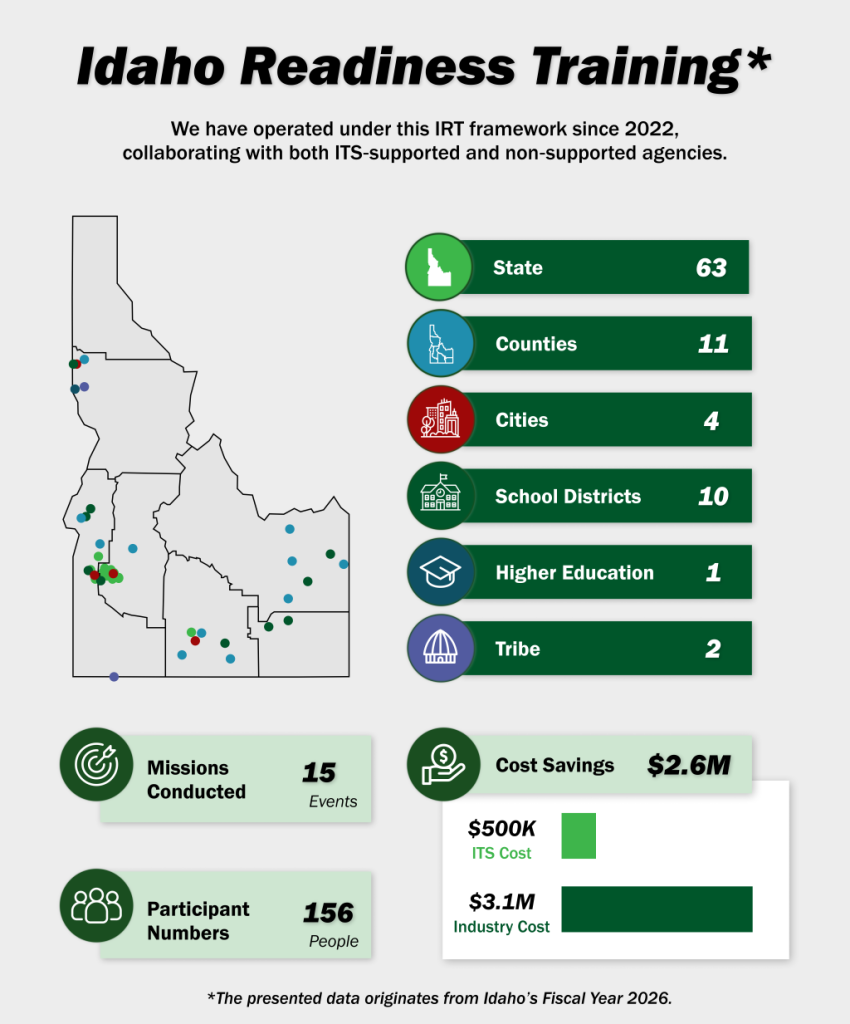
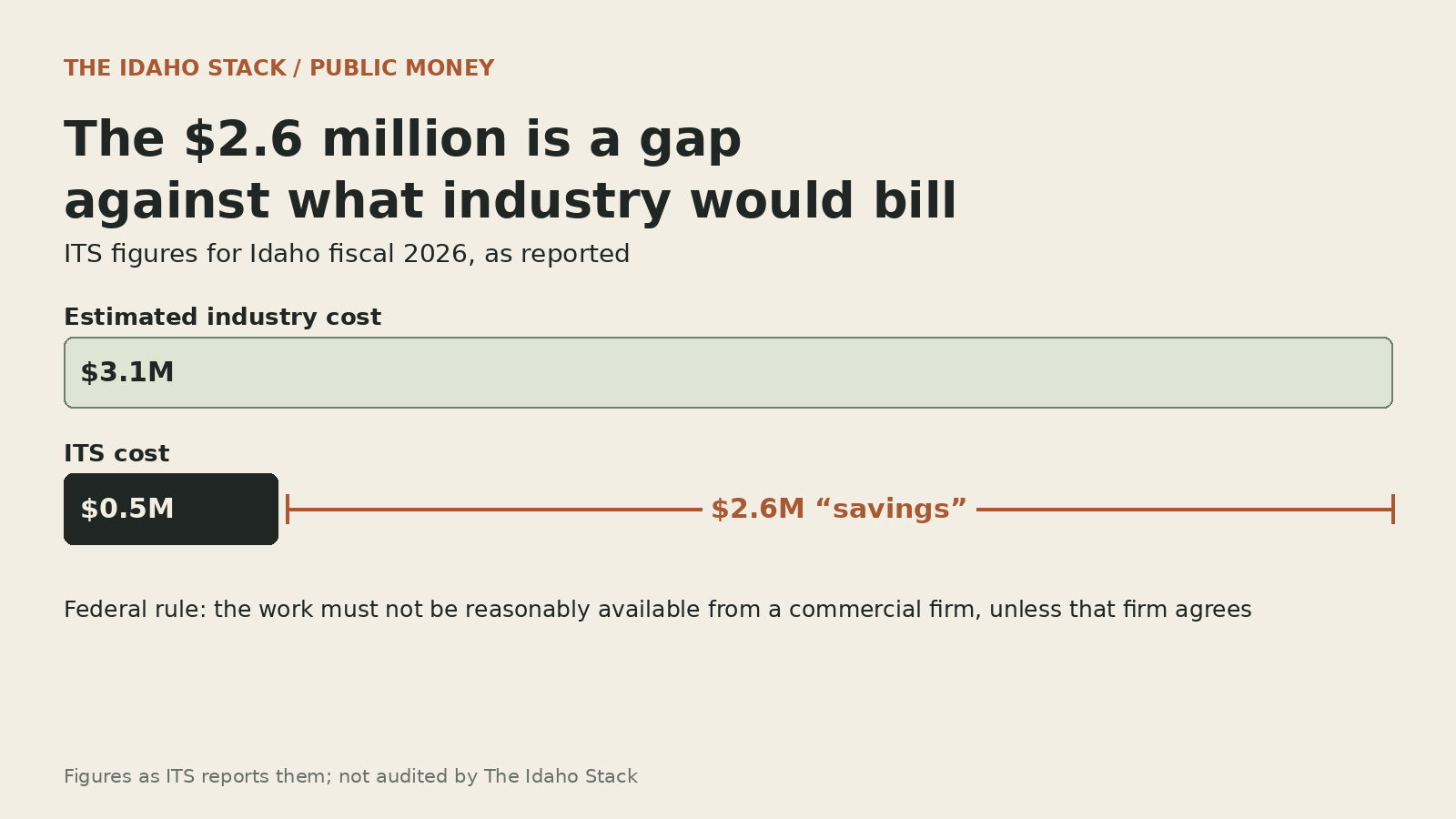
It also reports $2.6 million in total savings: $3.1 million in “industry costs” less $500,000 in ITS costs. In other words, the savings are measured against what private firms would have charged for the same assessments.
Eleven counties is one in four of Idaho’s 44. The page does not say which ones.
The rule the savings figure runs into
The Defense Department’s Instruction 1100.24, which governs the program, says an applicant “must affirm that the requested IRT support is not reasonably available from a commercial entity,” unless that business agrees. It also requires every applicant to advertise the proposed work twice, which matches the two notices ITS posted.
Both statements can be true. Commercial cyber assessments may not be reasonably available to small Idaho agencies at a price they can pay, and the “industry costs” line may simply be a yardstick. But the public records don’t show how ITS made the non-competition affirmation, how it estimated $3.1 million, or whether any firm responded to the notices.
Still unknown
The records also don’t say whether the problems the teams find get fixed. A 2025 GovTech report said the state planned grant-funded cybersecurity assessments for 25 to 31 local entities, with apprentices leading remediation under state oversight. That is a plan, not a result.
Sources and limits
Public records reviewed October 31 and November 1, 2026.
- ITS, FY 28 IRT Notice of Intent, posted August 27, 2026
- ITS public notices, including the September 14, 2026 second notice
- ITS, Innovative Readiness Training page, updated October 2, 2026, and its fiscal 2026 graphic
- DoD Instruction 1100.24, effective May 5, 2020, sections 3.3.f and 5.3
- Government Technology, July 8, 2025
Figures are as the state reports them; we have not audited them. Notices are statements of intent, not an approved federal request.