
Desk note · Public money · Research
Idaho Wrote a Payback Clause Into Its University Startup Grants. No Payback Was Ever Reported.
The state spent $10.9 million through IGEM before repealing the grant program in 2024. The program’s own reports never counted a license, a company or a dollar returned.
Based on public documents. No interviews were conducted.
In 2012 Idaho launched the Idaho Global Entrepreneurial Mission, or IGEM, to turn university research into Idaho companies. The Department of Commerce ran the grant side, awarding about $950,000 a year. The law also planned for success. Under Idaho Code 67-4731, once a funded project earned commercial revenue, the money first covered commercialization costs and the inventors’ shares. Of what remained, 25 percent went back to the state general fund until the grant was repaid, and 5 percent seeded future IGEM grants.
Commerce’s final IGEM report sums up eleven years of awards:
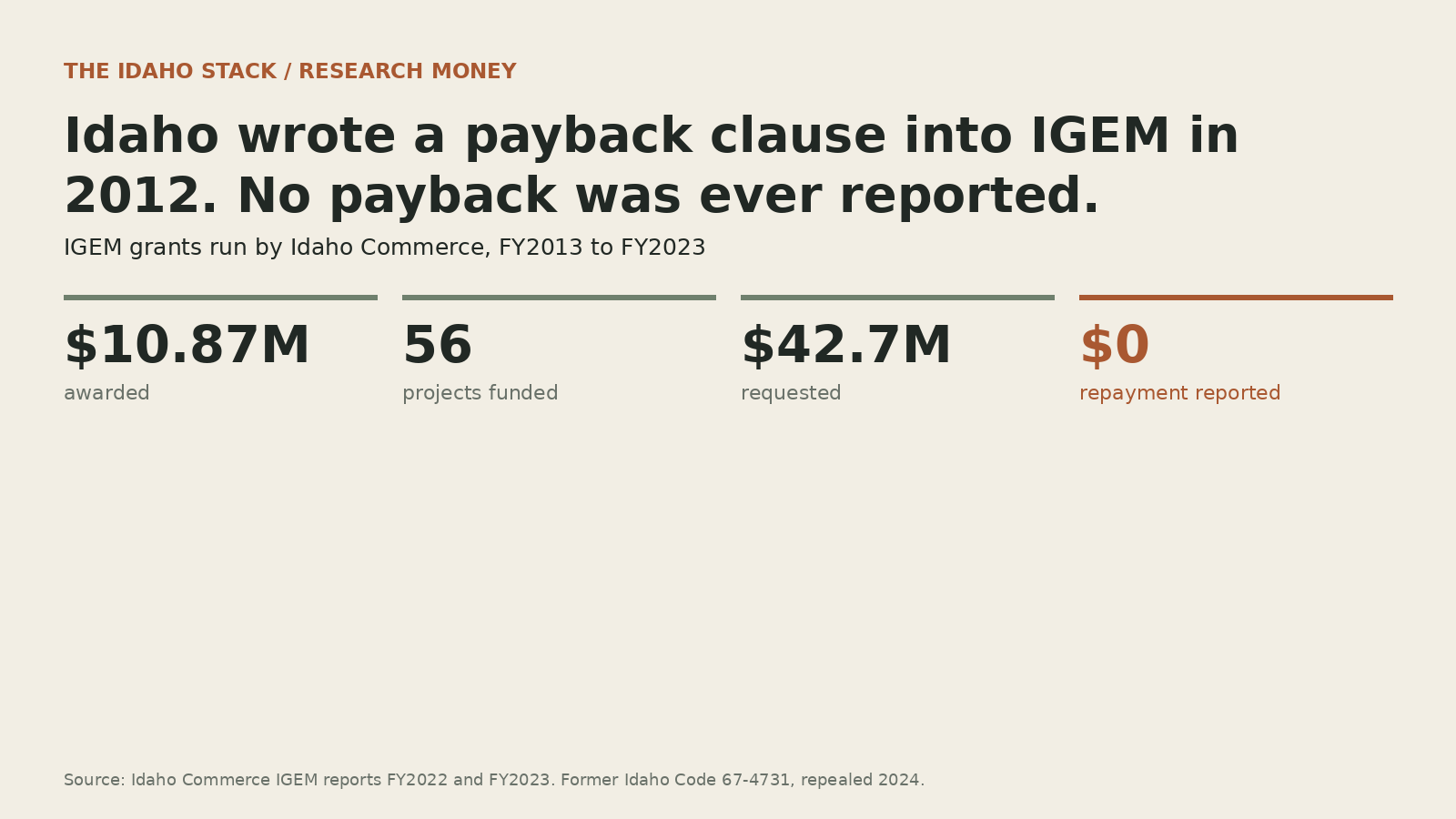
That last figure is an absence, not a line item. Neither the FY2023 report nor the FY2022 report counts licenses, startups, patents or commercialization revenue from Commerce grants, and neither mentions the payback clause. The FY2022 report offers one return figure, “ROI 1 : 1.5,” calling it “conservative,” without showing how it was computed. What the reports do document is follow-on money: several projects came back for supplemental grants, including the University of Idaho’s natural fiber insulation work with Hempitecture, which received $106,175 on top of its first award.
Repealed without an accounting
In 2024 the Legislature ended Commerce’s role. Senate Bill 1271 repealed the IGEM grant fund, the IGEM Council and the payback clause. It passed the Senate 35-0 and the House 67-2 and took effect July 1, 2024. Its fiscal note counts the result as a $1,000,000 yearly savings to the general fund. It says nothing about outcomes. The Legislature’s statute page still displays the repealed section’s text.
The program that survives
IGEM lives on at the State Board of Education’s Higher Education Research Council. In May, Boise State announced nearly $926,000 in IGEM awards from that council, with industry partners including American Semiconductor and NxEdge. Board policy III.W requires every funded project to “report annually on the quality, relevance, and impact of the project.” We could not find those reports published, or any count of what the surviving program has commercialized.
Commercializing research is slow, and a missing number is not proof of failure. But Idaho built a way to measure success into law, then repealed it without ever reporting against it.
What the public record doesn’t show
Whether any IGEM project ever triggered the revenue split, how much came back if so, and how many licenses or companies came out of IGEM grants. If you worked on an IGEM project, send us a tip.
Sources and limits
Public records reviewed November 6, 2026.
- Idaho Commerce, IGEM report FY2023, cumulative totals FY2013 to FY2023
- Idaho Commerce, IGEM report FY2022
- Idaho Code 67-4731, distribution of IGEM commercialization revenue (repealed effective July 1, 2024)
- Senate Bill 1271 (2024), bill history, and its statement of purpose and fiscal note
- State Board of Education policy III.W, Higher Education Research
- Boise State University, May 28, 2026
The FY2023 report’s totals table counts 56 funded projects; a passage elsewhere in it gives a lower count, 43 original projects and 8 supplemental grants. The S1271 fiscal note was written by the bill’s proponents. A project could have earned revenue that was never reported to Commerce; the reports simply don’t say.