
Public-document reporting & analysis · Rural health technology
Idaho’s Rural Health Awards Include the Technology Behind Mobile Care
Newly announced projects would bring equipment closer to rural patients. Idaho’s underlying plan also calls for shared technology, staff support and evidence that people actually use the new services.
Based on public primary documents. No interviews, clinic visits, patient records or tests of healthcare services were conducted. Project descriptions are attributed plans; the implementation analysis below is ours.
A mobile clinic can shorten a journey to care. The work also includes what happens around the visit: coordinating staff, connecting records and maintaining the equipment and software after the initial purchase.
That combination appears in Idaho’s October 28 announcement of first-year Rural Health Transformation Program awards. One southwest Idaho project explicitly joins vehicles and clinical equipment with care-coordination technology and data-sharing infrastructure.
For rural communities, this is a technology story with a physical destination. The award descriptions identify intended service areas. The earlier state application helps explain the wider systems work—and the difference between buying capacity and demonstrating access.
Two mobile projects show the local stakes
The governor’s office reports a $461,680 award to Southwest District Health for its Community Integrated Mobile Care Infrastructure project. Its plan includes two mobile healthcare vehicles, telehealth and diagnostic equipment, care-coordination technology and data sharing. The initial rollout would focus on Gem, Payette and Washington counties; later expansion would depend on needs and resources.
In eastern Idaho, the same announcement identifies $2,255,219 for Mountain View Hospital’s mobile healthcare clinic. Its planned reach includes Jefferson, Bingham, Fremont, Clark and Madison counties.
Those descriptions tell residents where the projects intend to work. They do not supply an operating timetable, appointment availability or proof that equipment has arrived. We have not independently verified service openings or signed project contracts.
The federal allocation and the state’s project awards are different stages
CMS’s October 28 release highlights Idaho’s roughly $186 million in first-year funding and says the state has committed the full amount. That release links back to the December 29, 2025 federal award announcement, whose Idaho row lists $185,974,368.
The October announcement therefore should not be added to December’s figure as another $186 million. The federal allocation, the state’s awards to projects, actual expenditures and available services are separate stages.
DHW’s funding page says first-year opportunities have closed and directs readers to updates on awards, procurement and start dates. Its linked award list is labeled “as of Oct. 16.” The project examples above come from the later governor’s announcement, rather than an independent review of the complete award list.
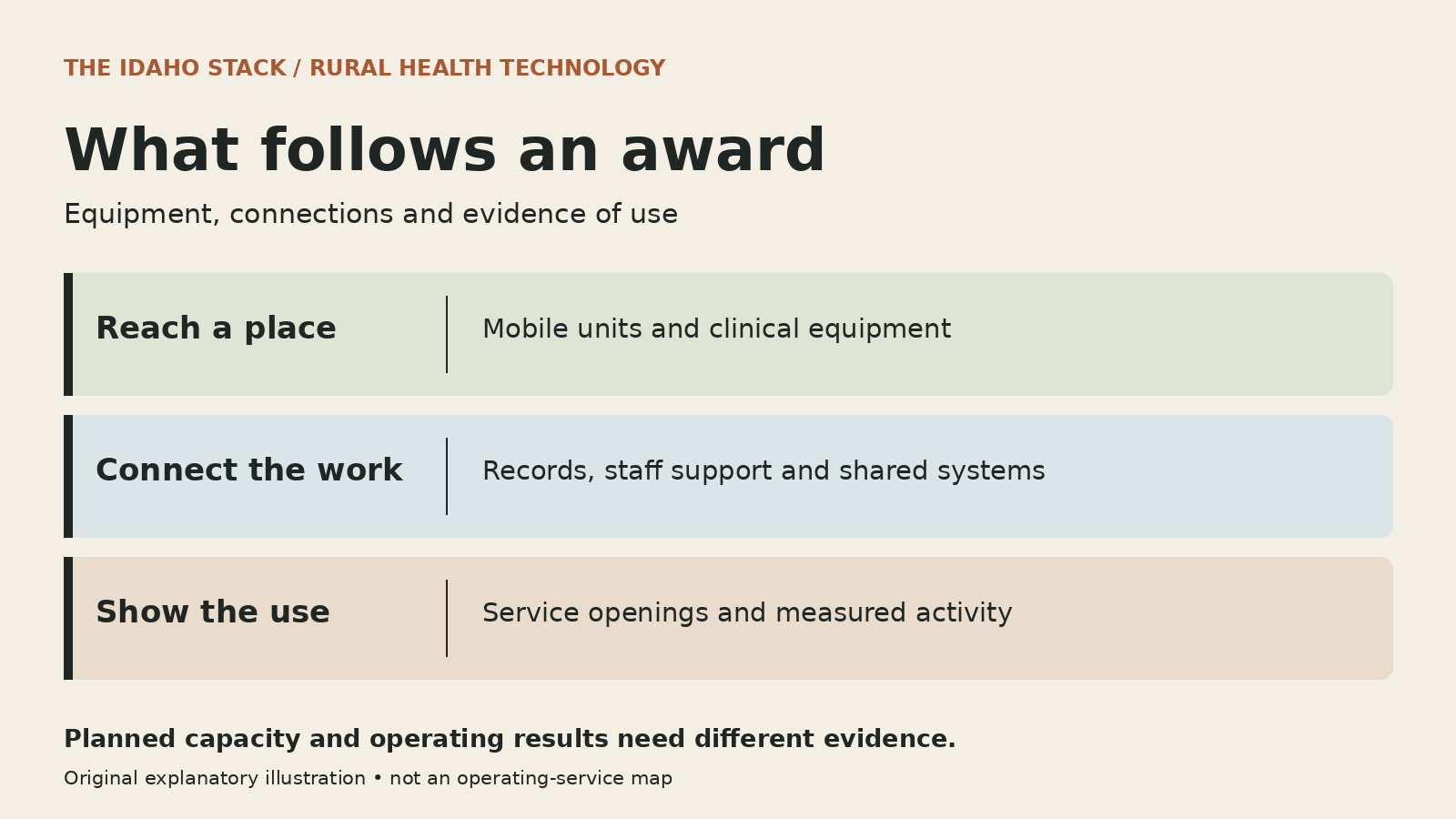
The original plan looks beyond a vehicle or software license
Idaho’s original application narrative proposes facility technology assessments before selecting infrastructure strategies. It also describes sharing IT support, cybersecurity resources and analytics tools among providers. The application was submitted in November 2025; these are planning intentions, not a current installation report.
That distinction matters for a mobile service. Having equipment near a patient and being able to use it within an ongoing care workflow are different tasks. A future opening announcement becomes more useful when it explains who operates the service, how a visit connects to a continuing provider and where people obtain current scheduling information.
The state’s funding page separately lists procurement pathways for technology assessment, cybersecurity assessment and data analytics/outcomes evaluation. A posting shows intended work. It does not establish a completed assessment, a chosen vendor or a functioning shared network.
Nor does the statewide plan mean that every mobile award uses the same software, connects to every hospital or participates in every technology initiative. The public documents reviewed here do not establish those connections.
Equipment counts and completed visits measure different progress
The application’s evaluation table separates facilities implementing or updating electronic health records from appointments completed through telehealth or remote delivery. For the latter, it records an unknown baseline and proposes a 50% increase by December 2030.
An unknown starting value cannot yield an absolute appointment target. It also should not be treated as zero use. This is what the original application said; we could not inspect the newer annual report and do not claim the baseline is still unknown today or that the target remains unchanged.
A later progress report could make the comparison meaningful by publishing the starting period, participating providers, completed-visit definition and current result. Even then, more appointments would be a measure of use, not by itself proof of improved health or reduced travel for every patient.
The narrative’s sustainability section also anticipates shared ongoing technology costs and future support. Those intentions make staffing, maintenance and recurring costs part of the follow-up reporting agenda.
The next development to watch is a verified service opening, followed by evidence of use over a defined period. That would show how an award becomes a dependable local service.
Sources and limits
Primary records reviewed October 29, 2026. This article concerns public funding and implementation, not an individual’s treatment or eligibility.
- Idaho governor, October 28 — project examples and intended reach.
- CMS, October 28 and December 29, 2025 — current announcement and original federal allocation.
- DHW funding page and program overview — closed first-year opportunities, procurement pathways, timeline and links to records.
- Original application narrative — pages 15–16, 52 and 58. Plans and targets are historical, not verified current performance.
The linked full award list and newer annual-report/budget files could not be read through the available retrieval tools. We did not audit the complete award portfolio, payments, contracts, software connections or clinical outcomes. No opening date, appointment, cost saving or care benefit is guaranteed here.