
Public-document reporting & analysis · Research Software & Business
INL’s New Software Funding Targets Browser Access and Easier Licensing
A research tool needs a usable form and clear terms. New commercialization funding involving Idaho National Laboratory aims to improve both, through separate projects for hosted applications and software storefronts.
Based on public primary records, rechecked October 26, 2026. No interviews, site visits, accounts or software testing were conducted.
INL’s October 22 announcement describes its participation in five federal Technology Commercialization Fund projects. Two software efforts offer a particularly practical way to read the news: one concerns how a tool is delivered, while another concerns how users obtain rights to it.
The lab’s notice cites Department of Energy selections announced September 24. October 22 is the INL announcement date, not a new award decision or a product launch. The useful detail is in DOE’s project descriptions and the software-access records already available.
ELEMENT aims to make research tools usable through a browser
INL leads ELEMENT, a project to convert research software into hosted web applications. DOE describes a goal of 20-plus tools across four laboratories over 24 months. The supporting labs are Lawrence Livermore, Sandia and Oak Ridge.
INL reports $1.8 million in federal funding and $400,000 in commercial-partner cost share for ELEMENT. Its announcement assigns a software-hosting role to the nonprofit INL Foundation, alongside partners working on marketplace development and outreach.
For a business evaluating a scientific model, browser delivery could change the practical work needed to get started. It could move installation and some computing responsibilities to the service operator. It would still matter what inputs the model needs, what its results mean and what support the operator provides. Those are product questions to verify, not completed capabilities established by an award.
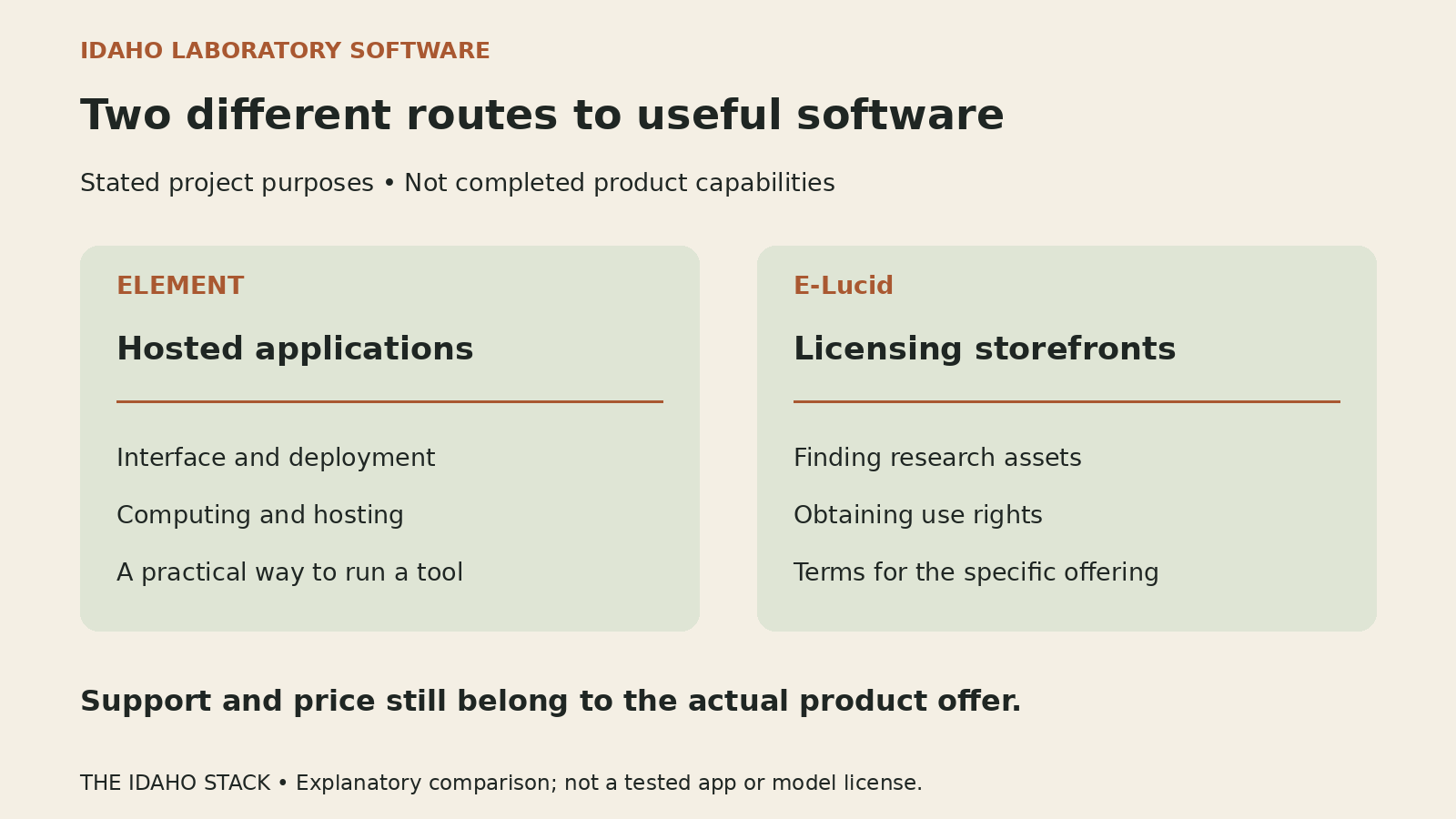
E-Lucid addresses the route to a license
A separate effort, led by Princeton Plasma Physics Laboratory with INL among the supporting labs, would expand E-Lucid software and data storefronts. DOE describes a coordinated marketplace and a streamlined, click-through licensing route for software and datasets.
There is already an INL Software Marketplace. Its public description includes research codes, models, spreadsheets and datasets, with both open-source and proprietary licensing options. The new project seeks to broaden that kind of distribution; the existence of a catalog does not make every listed asset an immediately usable hosted service.
INL’s licensing guide describes agreements with product-specific scope, terms and development milestones. Commercial arrangements may include fees and royalties. This is not a price quotation for every software item, and we have not examined an individual agreement.
A business therefore needs to establish what is being offered: a download, access to a hosted application, permission to develop a product, or some combination. The delivery format and the permitted use answer related questions.
FieldSim shows why the distinction is practical
An existing INL example makes the difference visible. The FieldSim research page describes a model that simulates agricultural machinery movement and estimates field efficiency. It lists Python and PythonPDEVS as free, open-source prerequisites. Its separate license section says the software “was not approved for public release.”
Free prerequisites do not establish the license of the application that uses them. The page is an undated research description, not a current commercial offer.
INL’s September 3 account of FieldSim describes a commercialization path: an exploratory research-and-development license, summer testing near Bozeman, Montana, and a planned commercial license. Those are the lab’s descriptions of that stage. They are not evidence of verified sales, measured savings or deployment on an Idaho farm.
Neither new project description identifies FieldSim as a selected ELEMENT tool or a new E-Lucid offering. It is used here to illustrate the questions a software user has to resolve, not to imply a connection to the new awards.
What a usable offer should explain
For Idaho builders, manufacturers or farm-technology businesses interested in laboratory software, the next useful product information will specify how the tool runs, the rights attached to it and who supports its use. A hosted service could reduce one burden while leaving other technical or commercial decisions to the customer.
The public opportunity is broader access to research that taxpayers helped fund. Evaluating that access requires looking at the actual offering: its requirements, terms, support and demonstrated results. Those details will tell readers more about a particular tool’s usefulness than treating every software award as the same kind of product.
Sources and limits
Primary records researched October 23 and rechecked October 26, 2026. Project goals and funding are attributed to DOE and INL. The distinction between delivery, use rights and support is our analysis; FieldSim is a historical example, not a newly verified award selection.
- INL announcement, October 22 — ELEMENT funding/partner roles and the September selection reference.
- DOE FY2026 project selections — ELEMENT and Scaling E-Lucid sections.
- INL Software Marketplace · INL technology licensing guide — public access routes and general terms.
- FieldSim research description · September 3 commercialization account — prerequisites, license descriptions and Montana trial context.
No actual application, license contract, current price, support arrangement, completed conversion, spending record or commercial outcome was independently tested or audited. No private software or customer data was accessed. Project goals do not establish current product availability; terms and support depend on the actual offering.