
Flagship · Public tech money · State systems
Idaho’s Biggest Agency Never Moved Its Money Onto Luma. Now It’s Deciding Whether to Stay Off.
Three years after the state’s statewide business system went live, the Transportation Department still pays its bills in a system it adopted in 2005, and it took a $13 million upgrade for that system out of next year’s budget only to see whether Luma can finally do the job.
Based on Idaho Transportation Board and legislative budget committee minutes, state evaluation and audit reports, the State Controller’s 2026 Luma survey, ITD’s own 2005 newsletter and StateScoop. No interviews were conducted.
When Idaho switched on Luma on July 1, 2023, the pitch was one system for the whole state: payroll, purchasing, budgets and accounting for every agency in one place. The largest agency by budget never fully made the move.
At a Joint Finance-Appropriations Committee hearing on February 5, 2026, then-Director Scott Stokes told lawmakers that the Idaho Transportation Department retained its existing finance system because integration with federal agency systems “proved too complex.” All of ITD’s data was ultimately transferred into Luma, the minutes say, but “payments, reimbursements, and accounting continued in the department’s Advantage system.” A full move to Luma “was planned for a later date.”
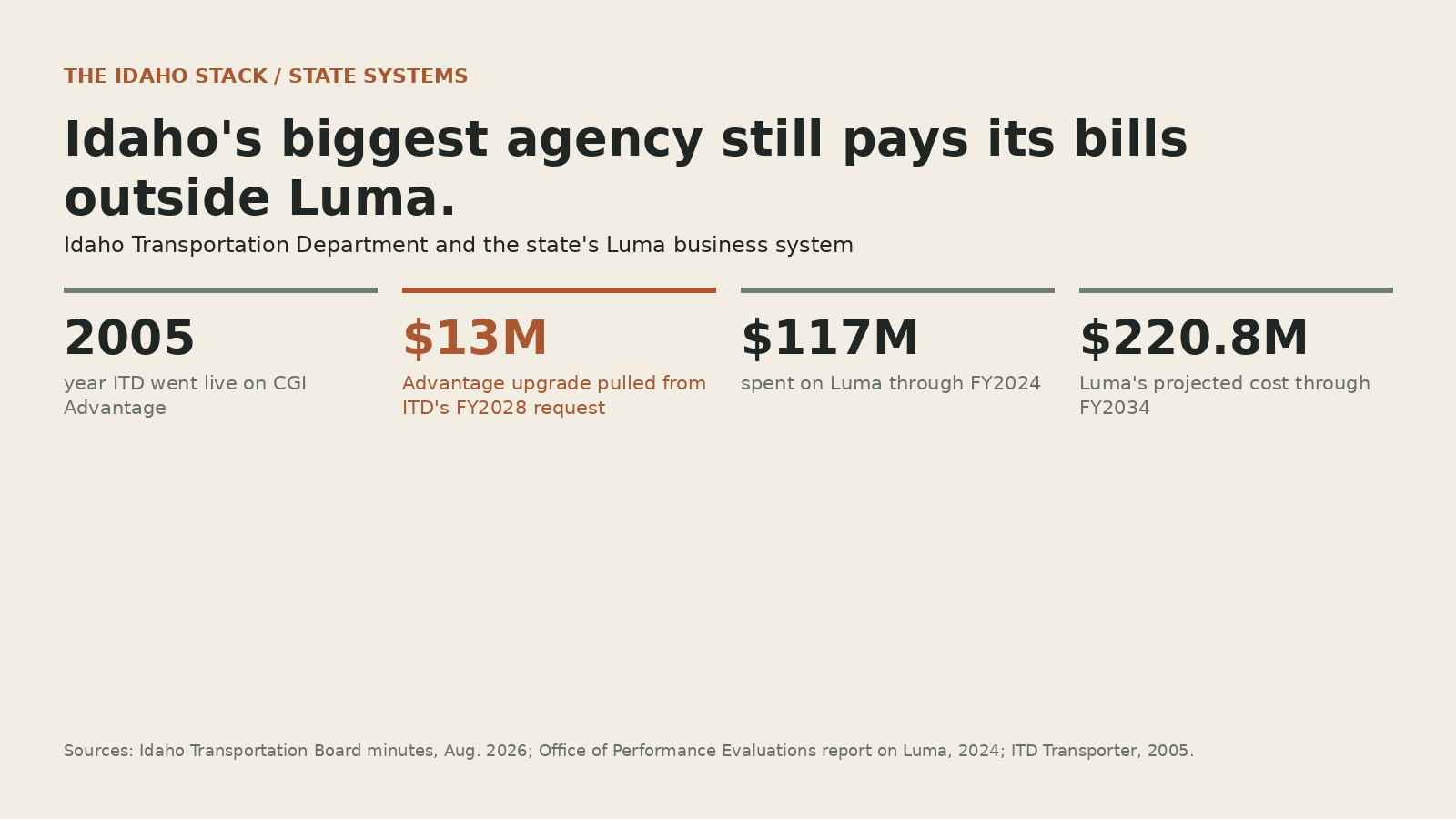
That later date has now become a budget question. At its August 20, 2026 meeting, ITD staff told the Idaho Transportation Board that a $13 million line item to upgrade CGI Advantage had been removed from the department’s fiscal 2028 request “to determine if Luma can accomplish ITD’s needs.”
What the board was told
The board minutes record an unusually frank exchange. Financial manager Kirk Weiskircher said “all software upgrades require the State Controller’s Office (SCO) approval,” and that “ITD’s preference is to keep Advantage; however, they understand changes have been made to the LUMA system to make it work.” The Controller’s Office, he said, is testing.
Board member Julie DeLorenzo asked who makes the final decision if the testing works out. Director Alberto Gonzalez said he had met with the Controller’s Office, the Division of Financial Management and the Division of Human Resources, and that they “have voiced concerns with Advantages project accounting.” Ultimately, the minutes say, “the Governor would decide.” Weiskircher added that ITD has cash reserves to put the line item back in if needed. The board then approved the 2028 request without opposition.
Gonzalez is an unusual person to be weighing this. Before he was named ITD director in July, he spent nearly four years as Idaho’s chief information officer, running the state’s Office of Information Technology Services, StateScoop reported.
Why it matters beyond one department
ITD moved onto Advantage, the system CGI sells today, in late 2005, when it replaced a financial system the department had used since 1998. The department builds and maintains roads with a mix of state and federal money, and tracking costs by project is the core of its accounting. That is exactly the function state officials now say worries them in Advantage, and the work ITD says Luma could not connect to federal systems for.
The choice has a cost either way. Keeping Advantage means paying for an upgrade on top of a statewide system Idaho is already paying for. The Legislature’s Office of Performance Evaluations reported in October 2024 that Luma cost $91.6 million to build and launch, that the state had spent $117 million on it through fiscal 2024, and that it would cost $220.8 million through fiscal 2034, with ongoing costs of about $9.8 million a year. Moving ITD fully onto Luma means migrating the state’s largest budget, a total program funding request of about $1.32 billion for 2028 including debt service, onto a system that state auditors and evaluators have repeatedly faulted.
That record is long. A root cause analysis commissioned by the Legislative Services Office and written by Baker Tilly in June 2024 found limited requirements analysis, incomplete testing and inadequate user acceptance testing; the Controller’s Office disputed those findings. The evaluations office found that for 9 of 36 business tasks, fewer than half of employees completed the task in Luma alone, and that one department spent $744,000 on software and contractors for functions Luma could not provide.
The Controller’s Office says things are improving. Its 2026 user survey of 2,059 state employees, taken in February, found 67% rated the system neutral or better, up from 54% a year earlier. Among the advanced users who run finance, HR, purchasing and budgets, the share was 57%, up from 44%.
What isn’t public yet
The documents leave the key questions open. They do not say what Advantage costs ITD each year to license and maintain, what the Controller’s Office testing has found, or whether the $220.8 million Luma projection assumed ITD would eventually move over. They also do not show whether any other agency still runs its core accounting outside Luma. The first answer should surface in January, when the governor’s 2028 budget shows whether the $13 million came back.
Sources and limits
Public records reviewed November 12, 2026.
- Idaho Transportation Board, regular meeting minutes, August 19 and 20, 2026
- Joint Finance-Appropriations Committee minutes, February 5, 2026
- Office of Performance Evaluations, Luma report, October 2024
- Baker Tilly, Luma system optimization root cause analysis for the Legislative Services Office, June 2024
- State Controller’s Office, 2026 Luma survey results
- ITD Transporter, October 28, 2005
- StateScoop, on Alberto Gonzalez’s move to ITD, July 2026
The fiscal 2028 figures are requests, not appropriations. The governor’s budget comes in January, and lawmakers set the final budget in the 2027 session.