
Public-document reporting & analysis · Business & public systems
ITD’s North Idaho Payroll Rollout Includes an Upload Option
A highway contractor’s move to digital reporting can begin with records the business already produces. ITD’s instructions offer a practical route for firms without payroll software—and a reason to check the details before buying an integration.
Publication record clarified October 26, 2026: this report was prepared and pushed October 20, but its first public-serving date has not been independently established. The unverified publication timestamp has been removed. Training sessions listed below are historical. Updated: .
Based on public agency, federal and vendor documents. No interviews, account access or payroll-file testing were conducted.
The Idaho Transportation Department’s certified-payroll rollout plan sets October 1 as the start for federally funded projects in District 1, with other districts following in phases. It says eComply will join the existing B2GNow system and describes using an organization’s existing login.
For a small business, a significant detail sits in the FAQ: firms without payroll software can upload certified-payroll documents. The agency’s described route therefore leaves a distinction between changing where records are submitted and replacing the application used to prepare them.
That distinction matters in District 1’s five counties: Benewah, Bonner, Boundary, Kootenai and Shoshone. The launch notice is about federally funded projects in that district. It does not establish one statewide changeover date for every road contract.
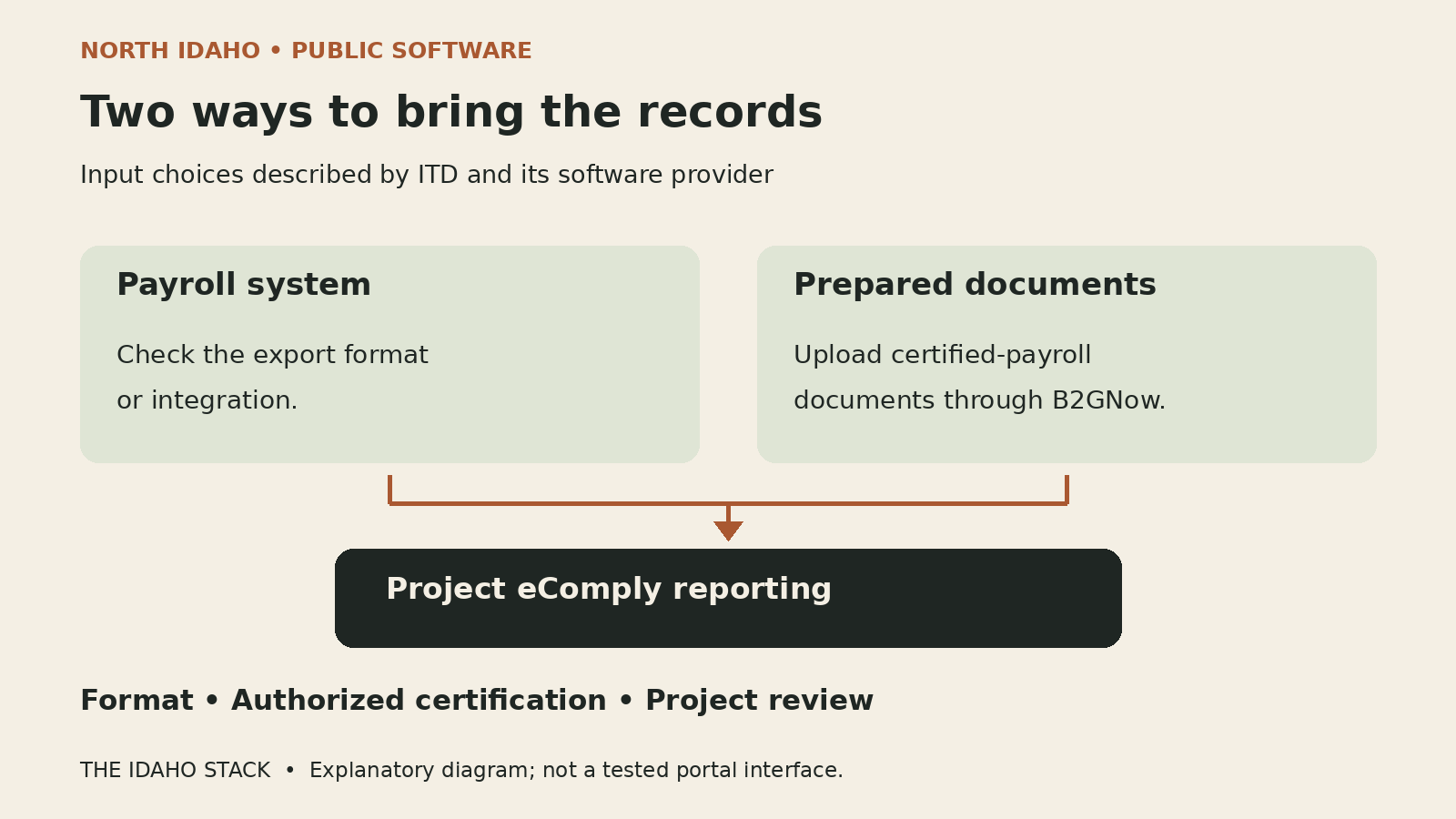
A provider name is the start of a format check
For businesses that already run payroll software, B2Gnow’s provider page lists products including ADP, QuickBooks and Paychex. It also lists particular export formats for some providers and says its list is not exhaustive. The vendor describes support for computer-readable payroll exports.
Those are compatibility claims from the supplier. We have not tested a connector, a particular software version or an ITD project configuration. A name on the list cannot establish that a firm’s existing export contains every field its project needs.
A useful preparation is to identify the actual file the business can produce, the person who can produce it and the project instructions that govern its submission. That gives a bookkeeper something specific to check. A general promise of automation cannot answer whether this week’s records will transfer correctly.
ITD says coordination for use of the system after the initial rollout will occur at pre-construction meetings. That is a concrete project-level place to establish which reporting route applies.
File transfer and certification are separate jobs
The underlying record has a purpose beyond getting data into a portal. The U.S. Department of Labor’s WH-347 instructions say covered contractors and subcontractors submit payroll information weekly, accompanied by a signed Statement of Compliance. The certification addresses the record’s completeness and accuracy and required wages and benefits for covered workers.
The same instructions distinguish the optional WH-347 form from the reporting obligation. They also accept legally valid electronic signatures and explain that a photocopied or scanned signature alone does not satisfy that requirement.
For an upload route, this creates a practical question: how is the authorized person’s certification completed under the project’s instructions? A document upload, a valid certification and agency review each establish something different. This article does not assess ITD’s signing implementation or determine compliance for an individual contract.
DOL’s compliance principles describe electronic reporting systems with conditions for signatures and continued records access. They also address alternatives when contractors cannot use or access an electronic system. Businesses should resolve that situation through the contracting agency’s process; this is not a promise that any particular alternative has already been approved for an ITD project.
Put the reporting task on someone’s calendar
ITD asks firms working on federally funded projects to have a team member take introductory and payroll/hourly-reporting training. The practical choice is who will prepare the records, who will certify them and who will follow up on their status. Those roles need to remain clear even if an export removes some data entry.
The vendor’s public training dashboard, checked October 20, listed a reporting session on October 21 at 10 a.m. Pacific and an introductory session on October 23 at 8 a.m. Pacific. The source lists Eastern time; these conversions are for North Idaho. Those dates have passed. Check the dashboard for current availability and any schedule changes.
A separate self-paced program describes five modules and estimates about an hour to complete them. Some videos may require registration. Neither a training listing nor a completed tutorial proves that a firm’s project access, file format or certification process is ready.
For small contractors, the useful next decision is narrow: establish the project’s submission route using the records and staff already available, then identify any remaining format or training need. That is a firmer basis for a software purchase than treating a new reporting portal as a requirement to replace the whole payroll setup.
Sources and limits
Public materials reviewed October 20, 2026. Agency instructions establish the announced scope and upload option; supplier documents describe compatibility and training. The workflow implications are our analysis. ITD’s page still describes the October 1 launch in future tense; we have not independently confirmed completed migration or account availability.
- ITD rollout plan and FAQ · District boundaries
- B2Gnow provider/format description · Training schedule · Self-paced training
- DOL WH-347 instructions · DOL compliance principles — official indexed text was accessible; direct page retrieval returned an access error.
We did not inspect an agency procurement contract, licensing prices, worker records, an authenticated portal or actual time savings. No payroll information was collected. Project-specific applicability, submission and certification questions belong with the contacts in ITD’s current guidance.
For a documented correction, send the claim and supporting source.